
Hazrat Fatima Zahras lasting legacy in shaping womens role in society
Across Iran, her birth anniversary is marked as Women's and Mother's Day — an occasion to reflect on the evolving role of women in Islamic society
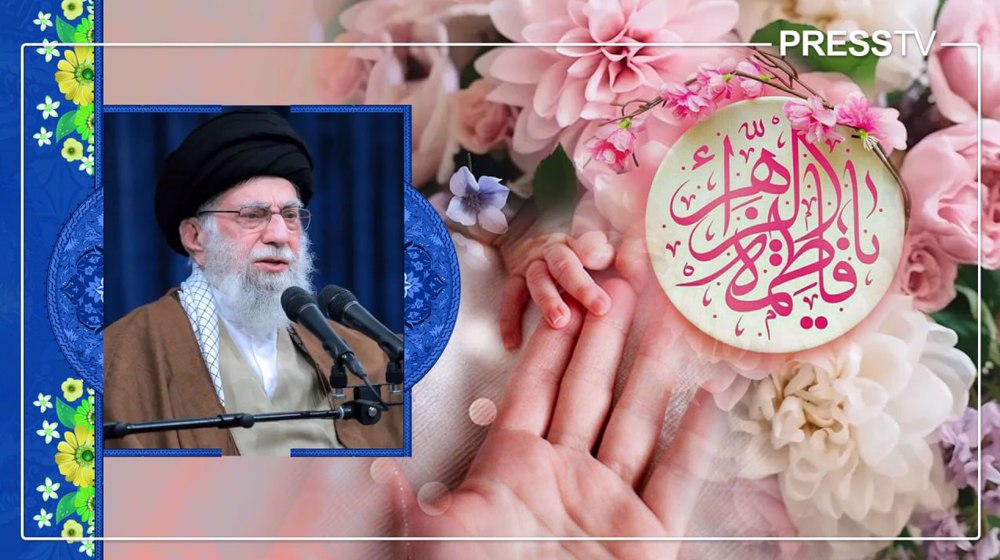
Every year, around this time, the streets of Tehran and other major Iranian cities are adorned with colourful banners, and women and men gather in mosques and community centers for cultural programs honoring the illustrious life of Hazrat Fatima Zahra (sa).
As the Leader of the Islamic Revolution, Ayatollah Seyyed Ali Khamenei, noted in his recent speech, the life and legacy of Prophet Muhammad’s (peace be upon him) beloved daughter stand as a beacon of inspiration for all Muslims.
Across Iran, her birth anniversary is marked as Women's and Mother's Day — an occasion to reflect on the evolving role of women in Islamic society, both private and public spaces.
For Iranians, it is not only a commemoration of a revered figure in Islamic history, but also a celebration of the ideals she embodied: her spiritual resilience, courage in adversity, moral integrity, and deep sense of social responsibility.
Hazrat Fatima Zahra (sa) is revered as a symbol of the highest ideals of womanhood — a benchmark against which courage, compassion, and leadership are measured.
Leader beyond her time
In his recent speech, Ayatollah Khamenei emphasized the extraordinary dimensions of Hazrat Fatima Zahra’s (sa) multifaceted personality, spanning the spiritual, political, human, and feminine realms.
He described her as the perfect role model for both women and men across eras, noting that her anger and pleasure correspond, according to Shia and Sunni narrations, to the anger and pleasure of the Almighty.
“It is truly magnificent and astonishing that a young woman, in terms of spirituality and her celestial and divine identity, could reach a level where, according to both Shia and Sunni narrations, her anger corresponds to the anger of God and her pleasure corresponds to the pleasure of the Lord,” the Leader said, addressing a gathering of women last week.
He added that Hazrat Zahra (sa), in her childhood, youth, married life, and overall conduct, represents the highest, most beautiful, and most eloquent role model for Muslim women.
“She shared in the Prophet’s (peace be upon him) grief during hardships, accompanied Imam Ali (as) in jihad, captivated the angels with her worship, delivered eloquent and fiery sermons, and raised Imam Hasan (as), Imam Hussain (as), and Hazrat Zainab (as).”
The Leader added that from her childhood to her youth, and through marriage and motherhood, she exemplified the pinnacle of Islamic womanhood — a figure whose life continues to inspire devotion, contemplation, and reverence.
Her unique qualities, deeply human at their core, embody patience in suffering, endurance amid hardship, and a tireless commitment to justice and family.
Champion of justice
Hazrat Fatima Zahra’s (sa) courage was most vividly expressed in her unwavering insistence on justice. Historical accounts describe her standing firmly against decisions that contradicted the Prophet’s (peace be upon him) guidance.
Muslim scholars believe she fearlessly confronted those in power, speaking with moral authority and refusing to compromise truth out of fear of retribution.
In his book Fatima is Fatima, Ali Shariati, the renowned Iranian sociologist, emphasizes that Hazrat Zahra’s (sa) life demanded constant vigilance and responsibility. She defended her family, guided her children, and ensured that societal and religious principles were upheld — demonstrating that women could exercise moral leadership even in the harshest environments.
Her advocacy also took practical form within her home and community, where she nurtured ethical responsibility and instilled in her children the principles that would later shape generations.
According to scholars and historians, even after her martyrdom, Hazrat Fatima Zahra’s (sa) life continued to reverberate across generations, igniting movements for social justice and shaping the moral compass of communities.
Her steadfast opposition to oppression became a benchmark for leadership and ethical responsibility — a standard that demands courage, integrity, and unwavering commitment from all who follow her example.
Spiritual legacy and universal values
The influence of Hazrat Fatima Zahra (sa) did not remain confined to the Arab world or Persia, it transcended borders.
The Pakistani poet-philosopher Allamah Muhammad Iqbal drew a striking comparison between her and Hazrat Maryam (sa), noting that while Maryam (sa) is honoured due to her relation to Jesus, Hazrat Fatima Zahra (sa) holds distinction through three extraordinary relationships: her father, Prophet Muhammad (peace be upon him), her husband, Imam Ali (as) and her sons, Imam Hassan (as) and Imam Hussain (as).

Write your comment.