

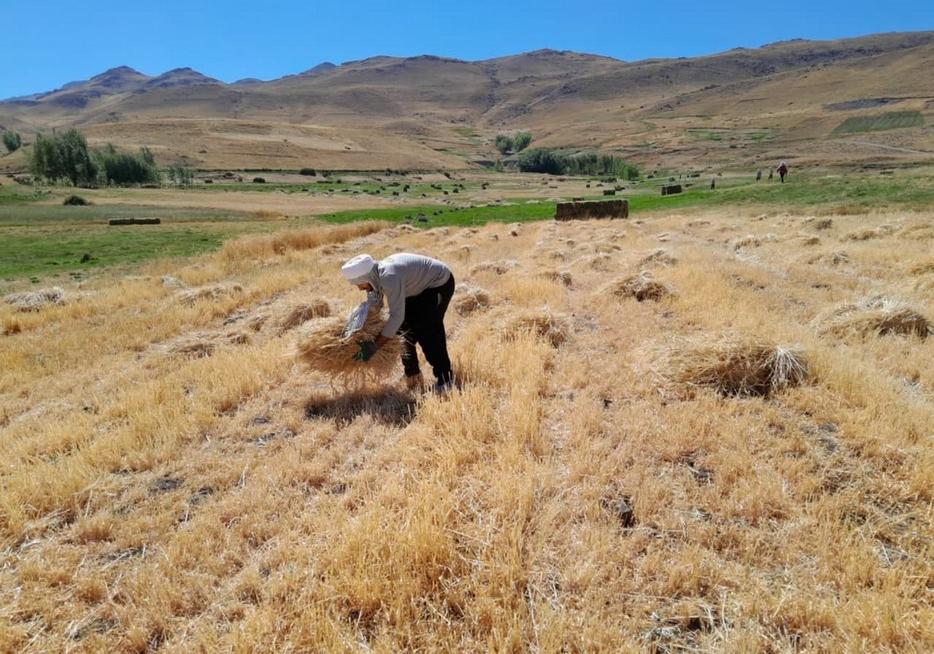
Since ancient times, humans have placed special importance on the harvest. In various communities and cultures, customs and rituals have developed around different stages of cultivation and harvesting—rituals that can be considered essential indicators of people’s lifestyle and beliefs. These traditions are especially prominent in cultures that rely on agriculture. Accordingly, similar rituals have existed in different regions of Iran as well. Although many of these customs have faded due to changes in lifestyle, some have remained intact and continue to be practiced. One such tradition is the harvest ritual of the village of Saqāy, which is still held annually without undergoing significant change.
Characteristics of the Harvest Festival in Saghay Village
The harvest festival in Saghay village is held on a Thursday in late June or early July (mid-Tir in the Iranian calendar). One of the key features of this tradition is its connection to religious beliefs. Two days before the ceremony, a respected elder of the village announces the upcoming event by reciting prayers and poems. As his voice echoes through the village, the residents begin their preparations—baking traditional bread and inviting fellow villagers who now live elsewhere to return for the celebration.
On the morning of the ceremony, families dress in new clothes and head toward Mount Pir-e Saqay in groups. This mountain is regarded as a sacred and respected place by the villagers. The collective procession toward the mountain, located south of the village, is one of the most striking and lively sights of the festival.
Upon arrival, each family settles in a spot and remains there until the afternoon, socializing and sharing stories. Elders recount memories, and those who have been away from the village reunite with relatives. At the foot of Mount Pir-e Saqay lies a spring called "Cheshmeh-Ali," where villagers perform animal sacrifices and cook meals from the meat. Part of the meat is also distributed to those unable to attend. The village’s agricultural harvest begins the day after the ceremony.
Where is the village of Saqay located?
Saqay is one of the villages in Varzaqan County, East Azerbaijan. It is a neighbor of the village of Yengejeh, where a ceremony similar to Saqay’s harvest ritual is also held.
Near Saqay lies an ancient cemetery, which, according to archaeologists, dates back to the first millennium BCE. This cemetery, known as "Saqay Cemetery 1," is located about 400 meters east of the village. Another cemetery, "Saqay Cemetery 2," lies one kilometer east and also dates to the first millennium BCE. Both cemeteries were registered on Iran’s National Heritage List in 2009 (1387 Solar Hijri).
History of the Harvest Ritual of Saqay Village
As the villagers narrate, the history of holding the ceremony goes back a long time and is considered an ancestral tradition. They consider the purpose of establishing this ritual to be giving thanks to God for the arrival of the harvest time. Holding the ritual on Pir Saqay Mountain, which is considered sacred by the people, shows how deeply this ritual is rooted in the spiritual beliefs of the people. According to experts' claims, archaeological excavations show that such rituals also existed in the region during pre-Islamic periods. Therefore, it can be suggested that this ritual is also a form of ancient rituals that has taken on a new shape over time based on people's beliefs.
National Registration of the Harvest Ritual of Saqay Village
This ritual was registered in the list of Iran's National Intangible Heritage in 2011 CE (1390 SH).