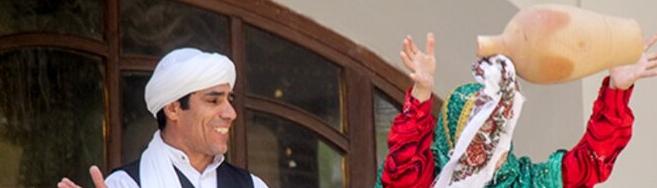
Qaen pottery breaking ceremony, a symbolic ritual on the threshold of the New Year
The beginning of the solar new year (late March) in Iran is accompanied by ancient rituals, each with its own distinctive beauty and characteristics. Among these traditions, Nowruz—recognized globally as an ancient cultural celebration—has been inscribed on UNESCO’s list of Intangible Cultural Heritage. Yet surrounding this major event, various customs are practiced across Iran, and learning about them reveals fascinating aspects of the lives and cultures of different Iranian communities.
In Qaen, a city in South Khorasan Province in eastern Iran, one such long-standing pre-Nowruz tradition is known as “Koozeh Shekani” (pot breaking). In this symbolic ritual, residents break old pottery vessels according to specific customs and replace them with new ones.
Geography and History of Qaen
Qaen County is situated in the southern part of South Khorasan Province. It is bordered by Khaf and Gonabad to the north, Ferdows and Sarayan to the west, Birjand and Darmian to the south, and Afghanistan to the east. The county shares approximately 130 kilometers of border with Afghanistan and covers an area of 17,832 square kilometers. The city of Qaen serves as the county seat and lies about 100 kilometers from Birjand, the provincial capital.
Historical texts indicate that Qaen is a region with a long-standing past that dates back to pre-Islamic times. At one point in history, Qaen was the largest city in the province of Kohistan—a historical region stretching across southern Khorasan and the central Iranian plateau.The county hosts three museums: the Anthropology Museum, the Museum of Notable Figures, and the Water Museum. The Water Museum is located in the old Bazaar cistern and showcases traditional techniques and tools used by the people of the region to harness and manage water resources. Exhibits include information on qanats and traditional systems of water distribution.
Saffron is Qaen’s most important and internationally renowned product. Due to the presence of some of the finest saffron in the world, Qaen is often referred to as the “Land of Red Gold.” With its deep historical roots, Qaen is home to a wide array of cultural traditions, among which the pottery-breaking ritual (Koozeh Shekani) is especially notable.
The Pottery Breaking Ceremony: Its Performance and Symbols
The pottery breaking ceremony is one of the rituals associated with the end of the (solar) year. Pottery is among the most widely used vessels for carrying and storing water in the arid regions of Iran, made from clay. Because water gradually seeps out of the body of the pottery, the water inside remains cool. However, after a period of use, algae grow inside the pottery, and the pores of the body become clogged with mineral deposits from the water. For this reason, a new pottery must be used, because if water is stored in such a pottery, its taste will change.
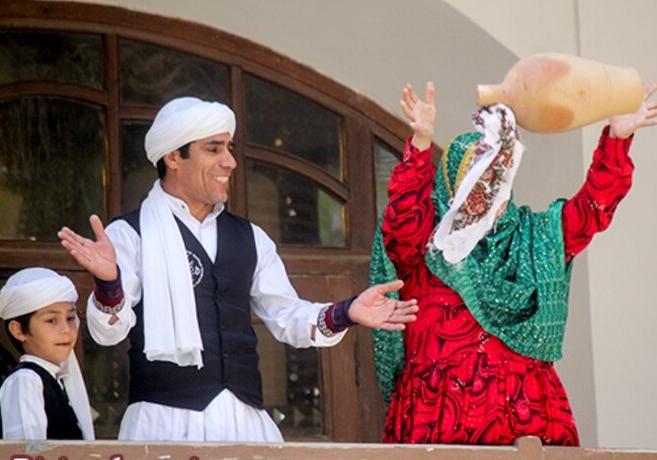
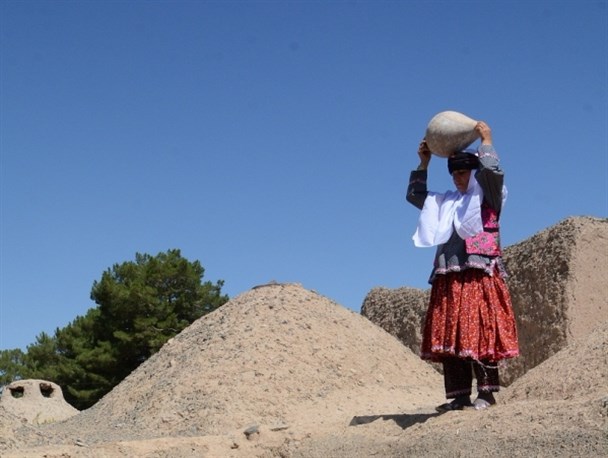
The pottery breaking tradition of Qaen is held on the last Wednesday of the year. In this ritual, a few pieces of charcoal are placed inside old, worn-out pottery that is no longer in use as a symbol of misfortune, some salt as a symbol of the evil eye, and a coin as a symbol of poverty. Then, the lady of the house circles the pottery around her head and other family members and throws it from the roof into the middle of the alley. The people of Qaen believe that this act removes misfortune and disease from the house and that the coming year will be filled with freshness, happiness, and prosperity. As they throw and break the pottery, the women chant these phrases: "Grief go away, joy come! / Hardship go away, sustenance come!" After breaking the pottery, new pottery are filled with water for use. Pottery breaking is a ritual filled with joy and happiness. At the heart of this ancient tradition, potters who had a meager income were supported, and a facet of Iranian culture in helping fellow human beings was displayed. Also, in accordance with the Iranian tradition of cleaning and tidying the house in preparation for the New Year, pottery breaking was also considered a ritual for renewing household items.
Experts believe that the pottery breaking ceremony has roots in ancient times. They believe that a similar ritual existed in ancient Iran. However, the existing evidence about pottery breaking in Qaen dates back to the Qajar period (19th century) at most.
National Registration of the Qaen Pottery-Breaking Ritual
The pottery-breaking ritual of Qaen was inscribed on Iran’s National Intangible Cultural Heritage List in 2013 (1391 SH).
| Name | Qaen pottery breaking ceremony, a symbolic ritual on the threshold of the New Year |
| Country | Iran |
| State | South Khorasan |
| City | Qaen |
| Type | National |
| Registration | National |

.jpeg)
Choose blindless
Red blindless Green blindless Blue blindless Red hard to see Green hard to see Blue hard to see Monochrome Special MonochromeFont size change:
Change word spacing:
Change line height:
Change mouse type: