


Daraei-Bafi: The Persian Art of Ikat Weaving
Daraei-Bafi (or Ikat) is the technique of weaving one of the most beautiful types of traditional fabrics. This art creates exquisite textiles by combining warm and captivating colors. In Daraei-Bafi, patterns are largely formed before the weaving process begins by creating strategic knots during the dyeing stage.
Characteristics of Daraei-Bafi
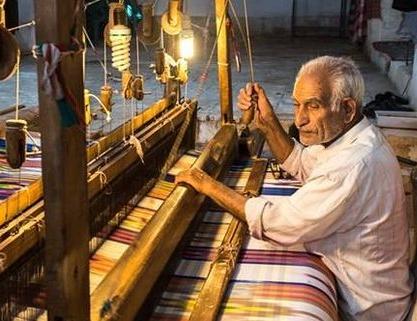
Daraei-Bafi is a textile technique produced by interlacing warp and weft threads made of cotton (and occasionally wool). Sometimes, these fabrics are woven with silk to increase their value and prestige.
The term Ikat refers to the binding of warp and weft threads according to a pre-prepared pattern. The unique feature of this art is the resist-dyeing of the yarns before they ever touch the loom. This is achieved through a knotting technique, which results in the diverse and vibrant color gradients characteristic of this fabric.
Why is it called "Daraei"?
In Persian, Daraei means "wealth" or "assets." It earned this name because of its high value; in the past, these fabrics were included in a bride's dowry as a significant financial asset. Due to the high price, only the wealthy could typically afford it. Historically used for bedspreads and tablecloths to be displayed prominently, it is now used for: Shawls, backpacks, night-wraps (Chador-shab), bundles (Boqcheh), coats, and various modern garments.
The Technique and Process of Daraei-Bafi
The weaving is performed on a specialized loom known as a Daraei machine. However, the most critical steps occur during dyeing. While natural plant dyes were used in the past, chemical dyes are now common for ease of use.
The Dyeing Process:
Bundling: Cotton or silk fibers are organized into bundles of 30 to 40 threads.
Mounting: The ends of these bundles are secured between two perforated wooden pieces.
Knotting: Bundles that are meant to share the same color are knotted together with thread. Because these knots are not perfectly airtight, dyes bleed slightly, creating beautiful, blurred color gradients.
Untying: Opening the knots before the dye is completely dry allows different colors to blend further, enhancing the visual depth.
The Weaving Stage: After dyeing, the warping (Cheleh-kashi) begins. Because Daraei fabric is somewhat elastic, the designs lack sharp, rigid borders. Common motifs include simple, large geometric patterns.
There are three primary methods of weaving Daraei: Warp Ikat, Weft Ikat, Double Ikat (Tarpood-e Doganeh): This is the most difficult and prestigious method. The artist may spend months weaving just a few square meters. In this method, both warp and weft threads are dyed according to a coordinated pattern.
To achieve maximum delicacy, a weaver may group as few as three threads per bundle, requiring immense precision in the knotting process.
National Heritage Status
Daraei-Bafi was registered on Iran’s National Intangible Cultural Heritage list in 2010. While it is most famous in the city of Yazd, the craft is also practiced in: Kashan, Gilan (Northern Iran), Turkmen communities.