

_1_crop_1.jpg)
Mehdi Dasht-Bozorgi is a graduate of Western Philosophy from the University of Tehran. He completed both his M.A. and Ph.D. degrees in Islamic Philosophy and Theology (Kalam) at Tarbiat Modares University. He was born in 1963 in Ahvaz, Iran. Since February 1999, he has been a full-time faculty member of the Department of Philosophy of Religions at the University of Kashan. At the University of Kashan, Dasht-Bozorgi teaches a wide range of courses, including Peripatetic (Mashsha’i) Philosophy, the philosophy of Mulla Sadra, classical and modern logic, Arabic language, English for specific purposes, Islamic mysticism (ʿIrfān), and Islamic theology (Kalam). He has translated three major works from English into Persian: My Intellectual Autobiography by Rudolf Carnap, Existentialist Theology by John Macquarrie, and Philosophy of Science by Alex Rosenberg. In addition, he has translated Ali and Divine Philosophy by Allameh Tabataba’i and An Introduction to Islamic Philosophy by Abdolrasoul Oboudiat from Persian into English. His original authored works include The Devil’s Bazaar, Mi’at Qissat Qasirah (One Hundred Short Stories), and Hidden Tears. Among his notable academic articles are Carnap and the Theory of Knowledge, A Response to Abu Zayd’s Critiques, and The Unity of Intellect and Intelligible: A Comparative Study of Avicenna and Mulla Sadra. All of his translations from Persian into English were carried out in collaboration with Dr. Fazel Asadi Amjad.
Studies in Islamic Philosophy
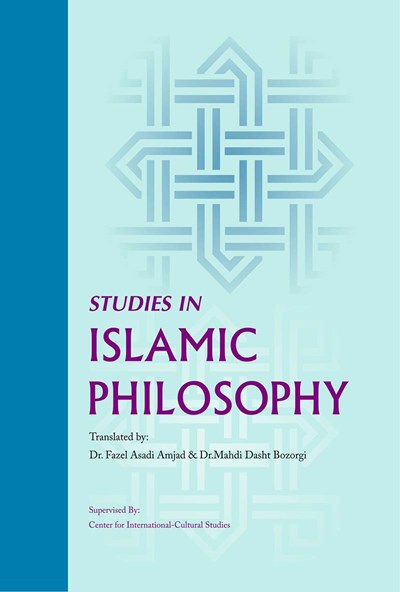
Dr. Fazel Asadi Amjad holds a B.A. in English Language and Literature from the University of Tehran, an M.A. in English Literature from the same university, and a Ph.D. in English Literature from the University of Glasgow. He is currently a professor in the Department of Foreign Languages at Kharazmi University. One of the significant works translated jointly by Dr. Dasht-Bozorgi and Dr. Asadi Amjad from Persian into English is Studies in Islamic Philosophy, a collection of philosophical essays. This volume brings together scholarly articles authored by Iranian academics and researchers, many of which were originally presented at academic and research conferences. The primary aim of this collection is to open avenues of dialogue between Muslim and non-Muslim philosophers and to provide a platform for critical engagement and the constructive presentation of philosophical ideas for the future. The essays explain the foundations of Islamic philosophical thought and reflect a shared consensus that Islamic intellectual traditions have paved the way for addressing contemporary and emerging intellectual needs. Muslim philosophers have played a crucial role in interpreting and explicating the principles of ancient Greek philosophy, particularly those associated with Plato and Aristotle. From the perspective of interpreting philosophical and theological issues within Islamic philosophical schools and the Muslim world, this book is of considerable importance to scholars and researchers in philosophy seeking new insights.
Throughout history, humanity has explored fundamental questions and necessities of life within frameworks such as culture, society, politics, and religion, yielding significant intellectual achievements. The profound influence of religious principles on these accomplishments cannot be overlooked. Even a brief examination of the history and culture of nations demonstrates the foundational role of religion in shaping human thought and civilization. Through translating this work, Dasht-Bozorgi and Asadi Amjad hope to deepen understanding of the role of religion in achieving these intellectual and cultural developments.
Philosophy of Science
Dasht-Bozorgi and Asadi Amjad have also sought to sustain this intellectual dialogue by translating Western philosophical works into Persian. One such work is Philosophy of Science by Alex Rosenberg. Philosophy of science encompasses various branches, including the philosophy of natural sciences, the philosophy of social and human sciences, the philosophy of history, and subfields such as the philosophy of law, economics, social sciences, and political philosophy. However, the focus of Rosenberg’s book is philosophy of science in its strict sense—that is, the philosophy of the empirical and natural sciences, particularly physics and philosophy of biology. Philosophy of science enables scientists to avoid a narrow understanding of their own disciplines and to better grasp the true position of science and experience. The book seeks to caution students of the empirical sciences against naïve positivist absolutism and to help them recognize that not all aspects of reality are reducible to sensory experience or experimental verification. Many essential human phenomena cannot be fully subjected to empirical testing; understanding such phenomena requires philosophical rather than purely scientific methods. Alex Rosenberg aims to demonstrate that the problems of philosophy of science are, in fact, fundamental philosophical problems. These issues manifest themselves in the ongoing efforts of scientists and students alike to comprehend the nature and limits of science.