

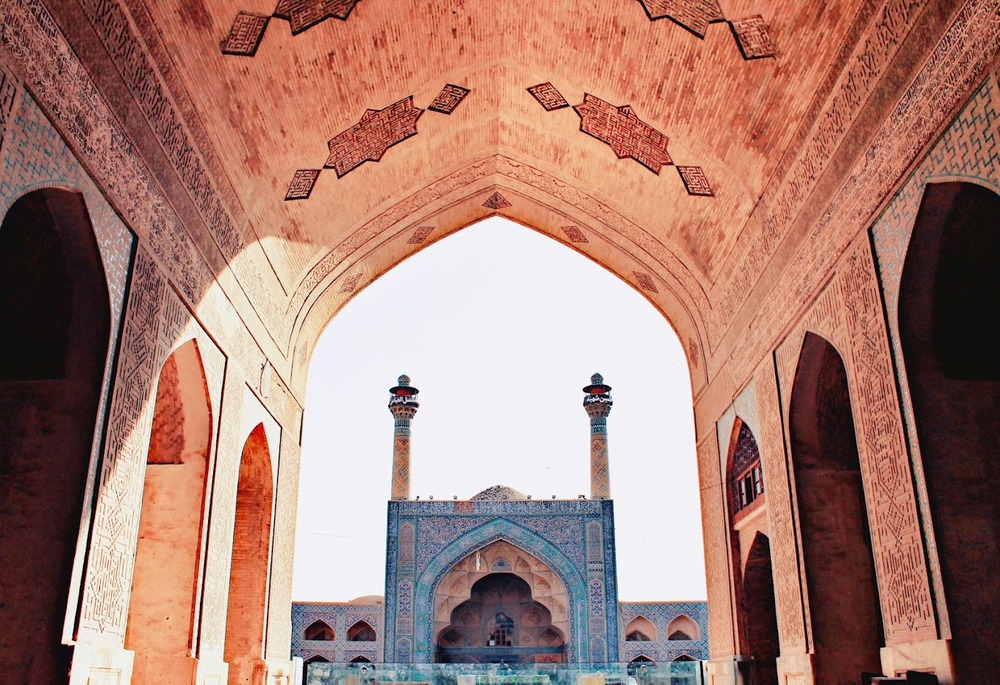
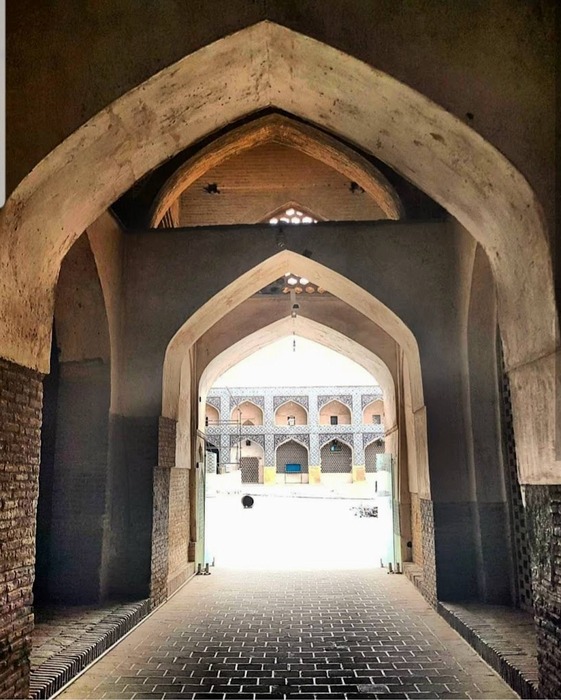
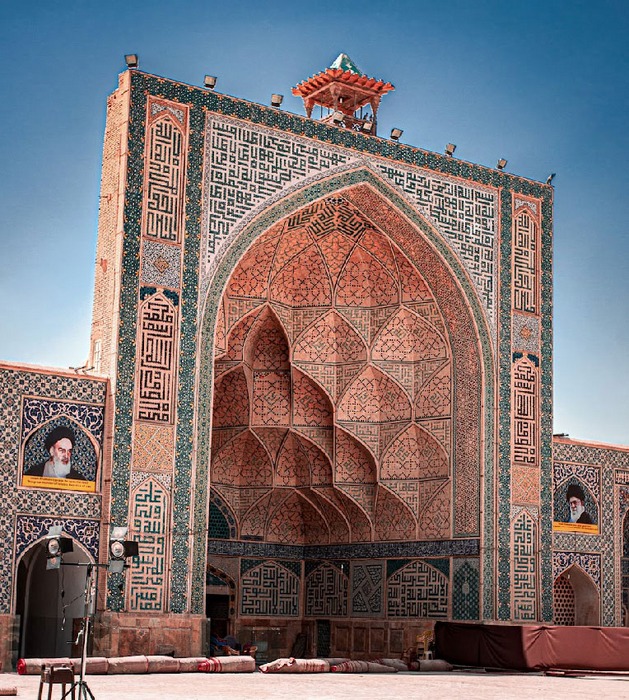
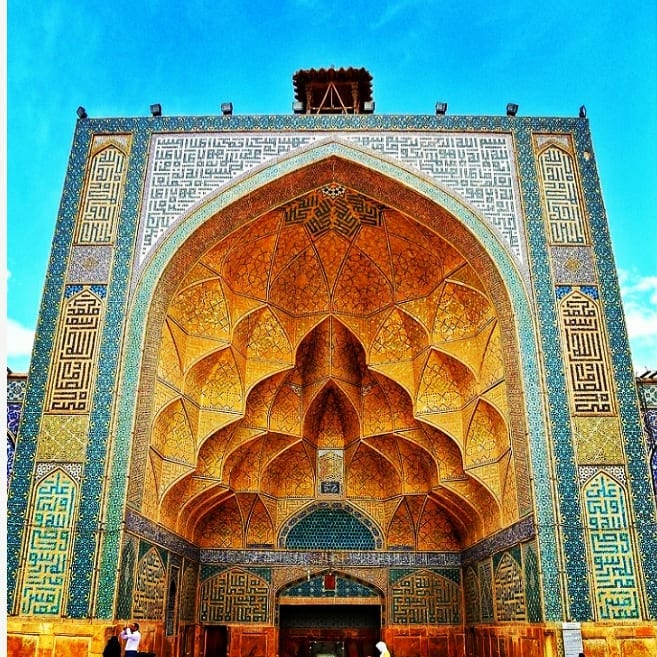
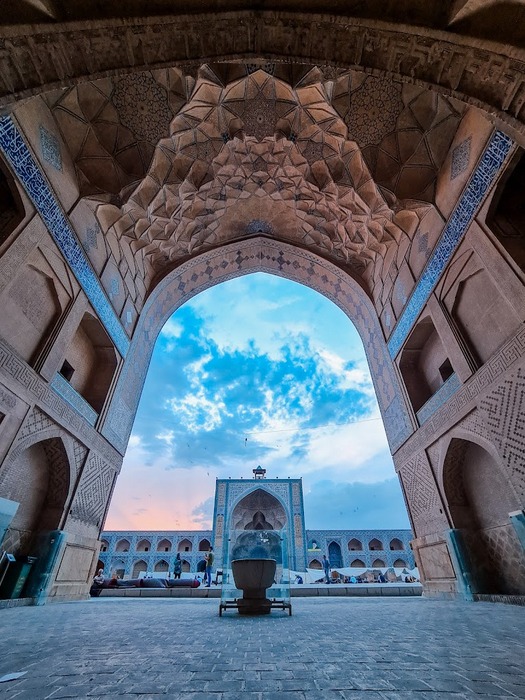
Among all the historic monuments of Iran, there is one that is not merely a building, but a book—a vast book whose pages are made of mud brick, fired brick, and tile, and whose walls tell the story of centuries of Iranian architecture. This is the Jameh Mosque of Isfahan, one of the oldest and most historically significant mosques in Iran, located at the heart of the city’s historic fabric. Unlike grand but single-period mosques, frozen in a particular moment of history, the Jameh Mosque of Isfahan is a living, evolving organism. Across many centuries, it has been built, altered, damaged, restored, and expanded. Here, by standing in a single place, you can trace major chapters in the history of Iranian architecture, from the early Islamic period through the Abbasid, Seljuk, Ilkhanid, Timurid, Safavid, and even Qajar eras—without needing a single guidebook.
The story of the Jameh Mosque of Isfahan, like that of many ancient mosques in Iran, begins with a transformation. Before the arrival of Islam, this site appears to have been associated with an earlier place of worship, and some traditional accounts connect it with a Sasanian Zoroastrian fire temple. The exact nature of the pre-Islamic structures, however, remains a matter of archaeological and historical debate. By the second century AH, corresponding to the eighth century CE, a mosque had been established here under early Islamic rule. It was a hypostyle, or Arab-style, mosque, in which rows of columns supported a roof over a broad interior space. Only limited remains of this early phase survive today, including the bases of some columns and sections of walls. These remnants nevertheless testify to the mosque’s early importance as a major religious building in the city.
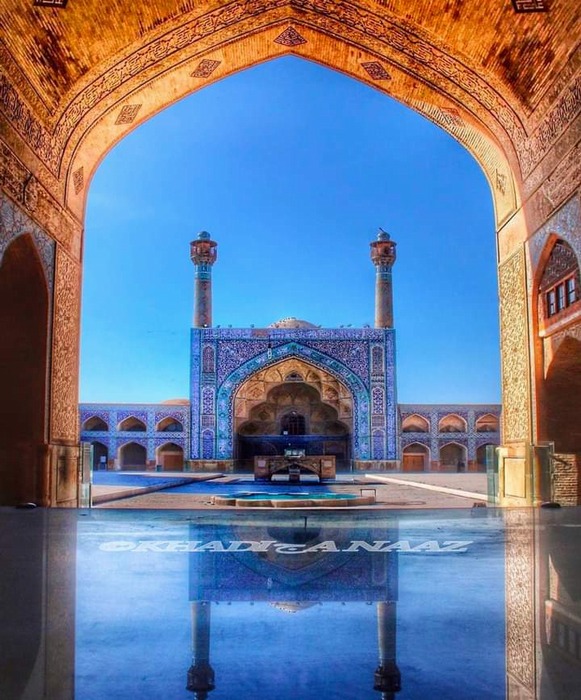
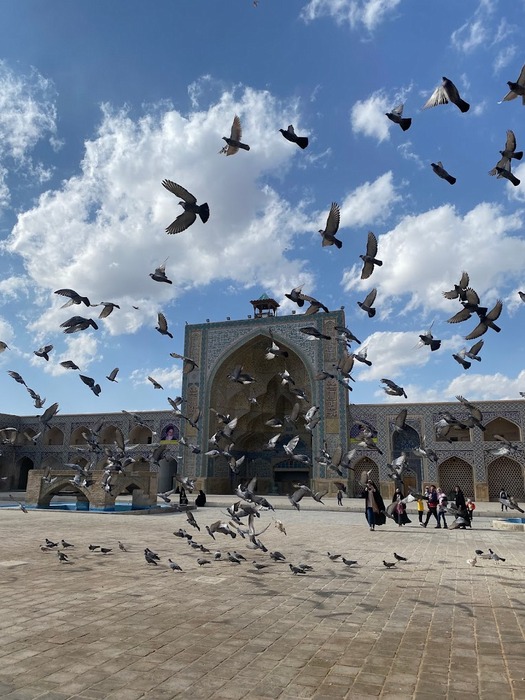
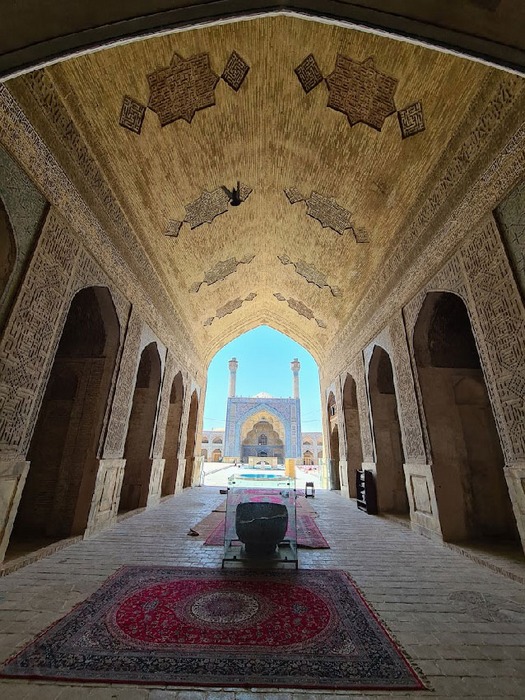
But the great transformation came in the fifth century AH, corresponding to the eleventh century CE, during the Seljuk period—a time that can be described as a golden age of spatial innovation in Iranian architecture. The Seljuks, who had emerged from the steppes of Central Asia, sought to create monumental spaces that reflected their growing power. They transformed the earlier hypostyle mosque into the Iranian four-iwan plan. In this innovative design, four iwans—grand, open halls with tall vaulted ceilings—are arranged around a rectangular central courtyard, creating a much stronger spatial hierarchy and a clearer directional organization.
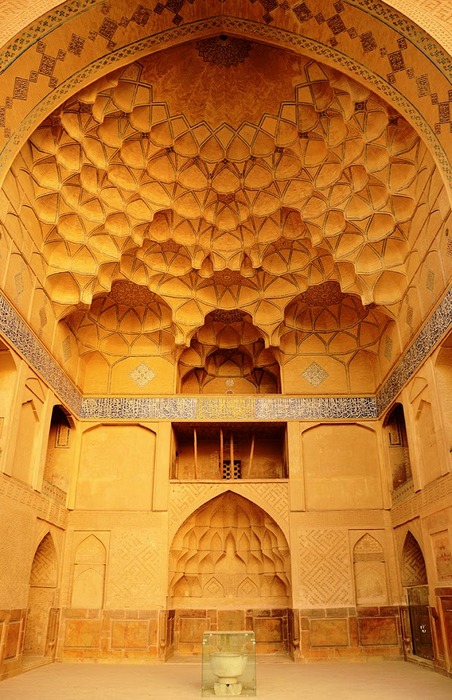
This transformation was a genuine spatial revolution. It turned the mosque from a largely uniform arrangement of columns into a more dynamic and hierarchically organized space, with the qibla giving the complex a clear directional focus. The southern iwan, with its soaring pointed arch and elaborate plaster muqarnas, became one of the most powerful expressions of this transformation. The four-iwan plan proved so adaptable that it became a defining model for many congregational mosques in Iran and later influenced mosque architecture across Central Asia, Afghanistan, and the Indian subcontinent.
But perhaps the boldest and most astonishing feature of the Jameh Mosque of Isfahan is its two great domed chambers, positioned at the southern and northern ends of the mosque and engaged in a silent yet deeply meaningful dialogue with one another.
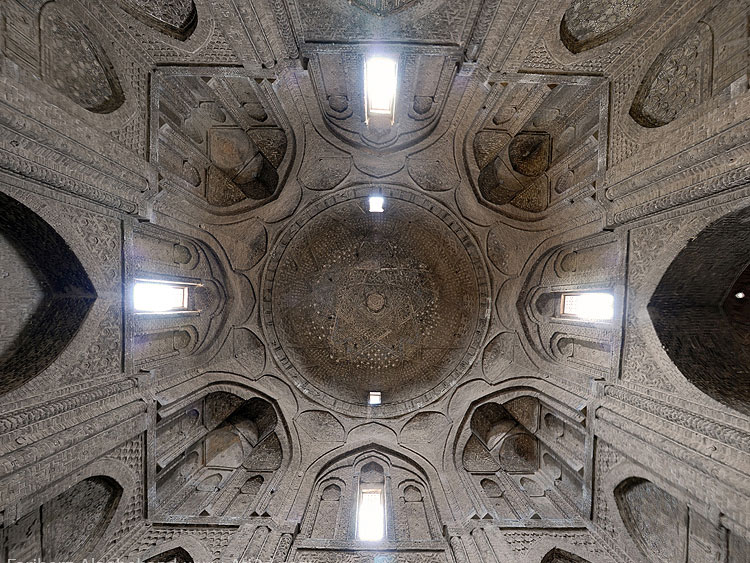
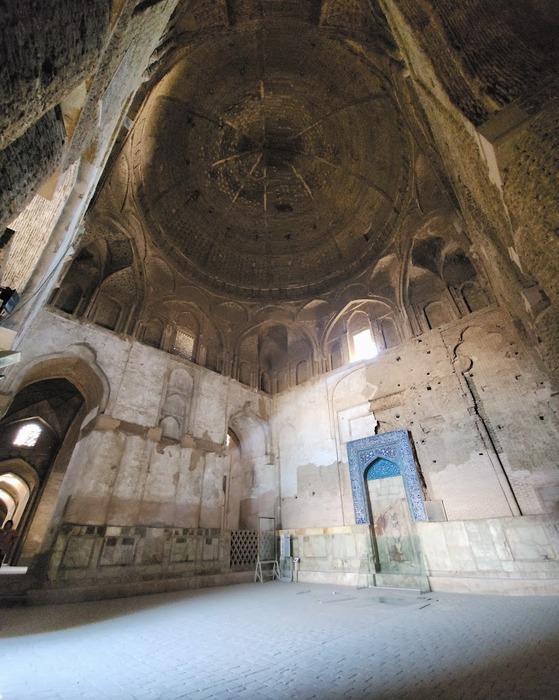
The Nizam al-Mulk Dome, on the southern side, was commissioned by the renowned and powerful Seljuk vizier, Khwaja Nizam al-Mulk Tusi, in the late eleventh century. This enormous brick dome, built over a square chamber, is both an engineering masterpiece and a political and religious statement. The architect of the dome—whose name has not survived in the historical record—used an ingenious system of squinches to mediate between the square chamber below and the circular base of the dome above. Through a carefully calculated sequence of geometric transitions, the architect created a monumental structure of remarkable stability and elegance.
The dome is remarkable not only for its scale and height, but also for its spatial clarity, mathematical proportions, and extraordinary sense of suspension. It represents a major achievement in the history of architectural engineering. Standing beneath it is an experience of being immersed in a vast, calm, and concentrated space, one that instinctively draws the eye upward toward the apex of the dome.
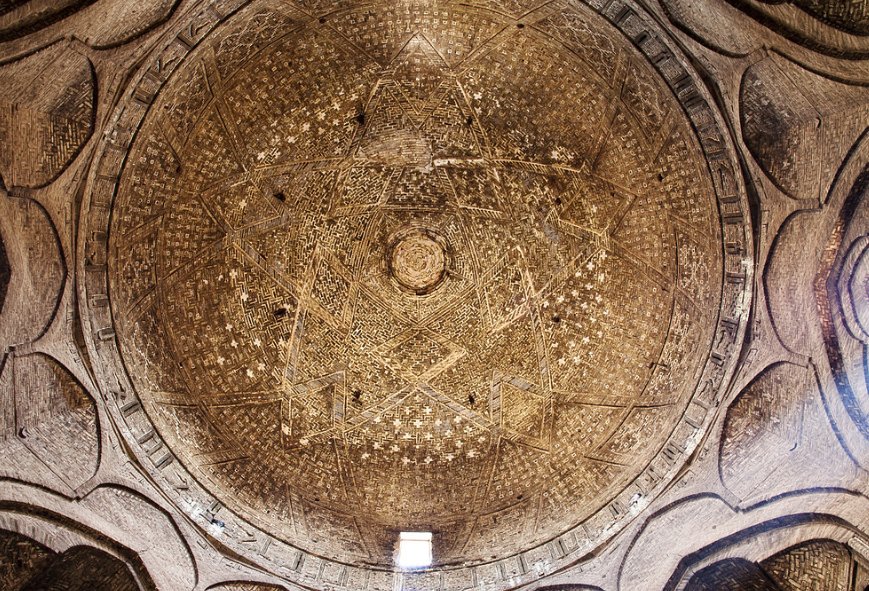
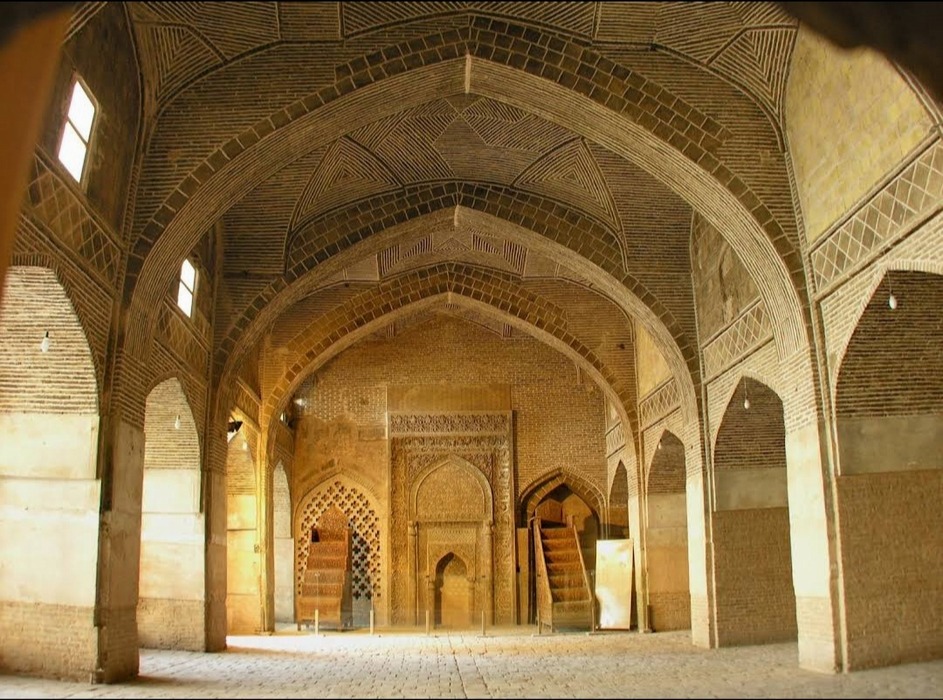
Directly opposite, on the northern side of the mosque, stands the Taj al-Mulk Dome, built several decades after the Nizam al-Mulk Dome, at the command of Taj al-Mulk, a powerful political rival of Nizam al-Mulk. Also known as the Khaki Dome, or Gonbad-e Khaki, it is smaller and more compact, yet astonishingly delicate and geometrically refined.
If the Nizam al-Mulk Dome can be read as an expression of power and grandeur, the Taj al-Mulk Dome can be read as an expression of elegance and geometric precision. Its squinches and intricate brickwork are executed with extraordinary care, creating the impression that the architect was composing poetry through mathematics and geometry. These two domes, facing one another at opposite ends of the mosque, form a remarkable architectural dialogue: a dialogue between power and elegance, boldness and precision, politics and art.
But the story of the Jameh Mosque of Isfahan did not end with the Seljuk period. Across the centuries, successive dynasties left their marks on the mosque, turning it into a multilayered manuscript of Iranian architectural history. In the fourteenth century CE, during the Ilkhanid period, the Oljaytu Mihrab was added to the western side of the southern iwan. This plaster mihrab, commissioned by Sultan Muhammad Oljaytu, is one of the outstanding masterpieces of stucco decoration in the Islamic world.
Here, plaster was not treated merely as a building material, but as a medium for creating extraordinarily intricate arabesques, floral motifs, and Kufic and Thuluth inscriptions. The Oljaytu Mihrab is so delicate and richly ornamented that it seems as though a lacework of light and patterns has been spread across the wall. During the Timurid period and later under the Safavids, exquisite mosaic tilework and haft-rang tiles, in shades of turquoise, deep blue, yellow, and white, were added to parts of the mosque, transforming its courtyards, iwans, and façades into a vast canvas of color and pattern.
The western iwan, often associated with the Ustad Iwan, preserves an especially striking example of the mosque’s later decorative layers, including Safavid-era tilework. Even during the Qajar period, additional features and decorative elements were introduced, carrying the story of the mosque forward toward the modern era.
What makes the Jameh Mosque of Isfahan unforgettable and deeply instructive for today’s audience—whether architects, historians, or travelers—is its simultaneous continuity and change. The building is a manifesto against the idea of architecture as something “finished,” “complete,” and “untouched.” The Jameh Mosque shows that an architectural masterpiece does not necessarily have to be the product of a particular golden age or the work of a single genius. It can instead emerge from a collective dialogue, gradual evolution, and shared creation over the course of centuries.
Here, each generation has added its own voice while respecting the legacy of those who came before, without necessarily silencing earlier voices or erasing their traces. This kind of “democratic architecture,” in which history accumulates layer upon layer like sediment, offers a powerful lesson for our own time—an age in which excessive demolition and redevelopment can so easily erase historical memory. The Jameh Mosque of Isfahan reminds us that a great building is never truly “finished.” It is always in the process of becoming.