

Kofteh-gari: The Art of Metal Inlay
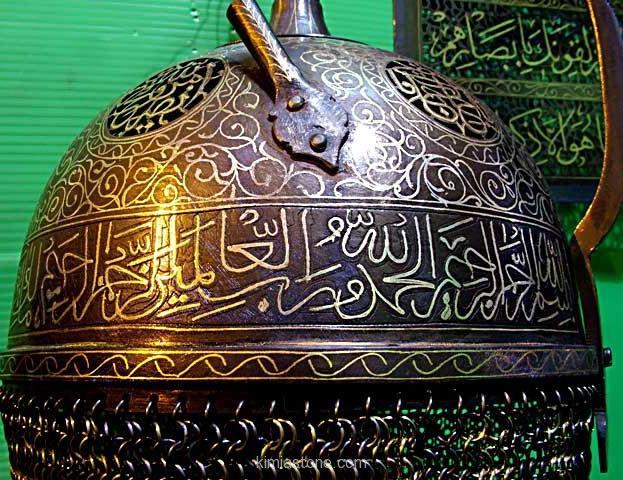
Kofteh-gari (steel inlay) is a traditional metalworking technique used to decorate metal objects through the inlaying of precious or semi-precious metals. Depending on the material employed, the practice is known by different names; however, its defining characteristic remains the seamless integration of the inlaid metal into the surface of the base material, giving the impression of a unified composition rather than an applied ornament.
Historical Background
Scholars generally agree that contemporary Kofteh-gari represents an evolved form of a metalworking tradition that can be traced back to the Achaemenid Empire (first millennium BCE). During this period, related techniques were employed in the production of seals and in the embellishment of weapons, including swords, shields, and armor. Although the craft persisted in subsequent centuries, it underwent notable development during the Seljuk period (1037–1194 CE), when both its technical sophistication and artistic range expanded.
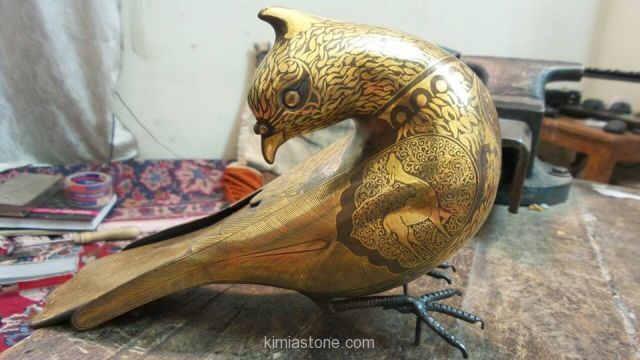
Following the establishment of the Safavid dynasty in the sixteenth century and the formal adoption of Shiʿism as the state religion, Kofteh-gari acquired a pronounced ritual and symbolic function. It was extensively applied to the decoration of Alams (mourning standards), with the later inclusion of animal motifs further enhancing their visual prominence. The tradition continued into the Qajar period (nineteenth century), during which the increased production of religious standards contributed to the sustained prominence of the craft. In contemporary practice, Kofteh-gari remains active in the fields of sculpture, metal ornamentation, and the fabrication of ceremonial objects associated with religious observances.
Techniques and Production Process
The creation of a Kofteh-gari object begins with the preparation of a design, which is initially drafted on paper and subsequently transferred onto a steel surface. The metal is then cut according to the design and heated in a furnace until it reaches a red-hot state. At this stage, it is hammered on an anvil to achieve the desired three-dimensional form, after which individual components are welded together to complete the structure.
Once the form is finalized, the inlay process commences. Fine wires of gold, silver, brass, or copper are embedded into the surface using specialized hammers. Prior to inlaying, the surface is carefully incised to create grooves that secure the wires. In some cases, controlled hammering is employed to enhance depth and dimensionality.
The scale of Kofteh-gari works varies considerably, ranging from large sculptural forms to highly delicate objects such as prayer beads and knife handles.
An optional stage known as Yashm-kubi (fixing) involves rubbing jade—or occasionally agate—over the inlaid surface to drive the metal wires more firmly into the grooves. The final stage consists of polishing, during which water, acidic solutions, detergents, and heat are applied to remove impurities, strengthen the surface layer, and enhance its luster.
Materials and Regional Variations
The terminology used to describe Kofteh-gari varies according to the inlaid metal, resulting in designations such as Tala-kubi (gold inlay), Noqre-kubi (silver inlay), and Berenj-kubi (brass inlay). Each variation demands distinct technical approaches. In particular, gold and silver inlaying requires exceptional precision due to the softness and thinness of the wires, necessitating specialized tools and refined manual control.
At present, Tehran, Isfahan, and Mashhad constitute the principal centers of silver inlay production in Iran. Beyond sculptural applications, the technique continues to be widely used in the decoration of Muharram mourning standards and selected metal vessels. The enduring association between Kofteh-gari and Muharram rituals—among the most significant religious observances in Iranian society—has played a crucial role in preserving and revitalizing the craft across generations.
Patterns and Aesthetic Principles
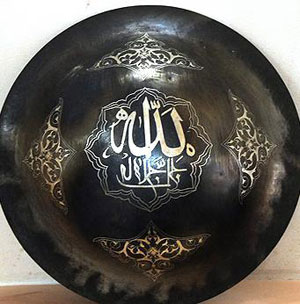
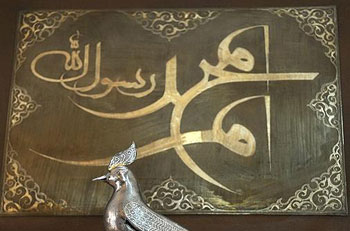
The decorative repertoire of Kofteh-gari commonly features Eslimi (arabesque) and Toranj (medallion) motifs, reflecting the continuity of Iranian artistic traditions. A defining aesthetic feature of the craft lies in the deliberate contrast between the darkened background metal—often oxidized or chemically treated steel—and the luminous surface of the inlaid metals. This chromatic opposition enhances visual clarity and reinforces the ornamental impact of the designs.