

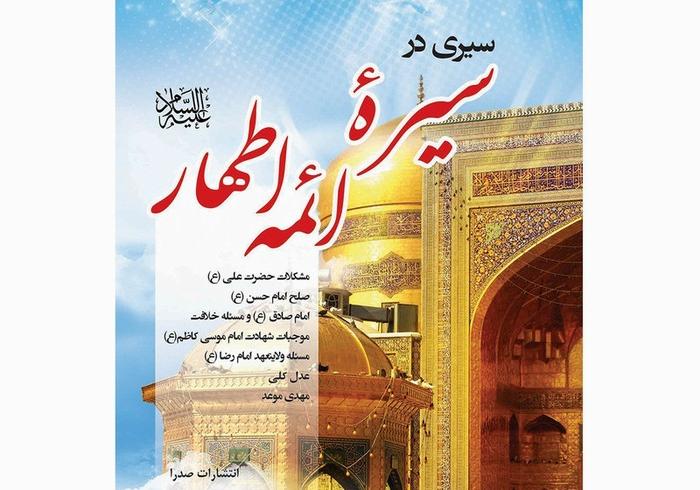
Taqiyya (pious dissimulation) is a struggle strategy employed by the Shia Imams, based on which they chose their methods in a way that minimized harm to themselves. If Taqiyya is the right course of action, why did Imam Hussain (PBUH) not practice it? And if it is not right, why did the other infallible Imams practice and command it? The book "A Survey into the Biography of the Infallible Imams" opens by posing this very question. By raising this inquiry, Martyr Motahhari seeks to compare the approach of Imam Hussain (PBUH) with that of the other Imams. This content, which serves as the book's introduction, has been selected from the handwritten manuscripts of Martyr Motahhari. In addition to the introduction, the book consists of eight chapters. These eight chapters have been compiled from various speeches delivered by the thinker and martyr, Murtaza Motahhari, at different times and locations. The biographies of the Shia Imams are presented briefly and concisely in this book, allowing readers to familiarize themselves with some of their moral virtues and practical lifestyles, and to adopt the Imams' way of life as a model.
The Challenges of Imam Ali (AS)
Following the introduction, the first chapter of the book is dedicated to the challenges faced by Imam Ali (AS) both before and after accepting the caliphate. In this lecture, Martyr Morteza Motahhari answers the question: why was Imam Ali (AS) reluctant to accept the caliphate? The author emphasizes Imam Ali’s final ultimatum to the people, where he clearly stated: "If I take the reins of the caliphate, I will act as I know best, not as you expect." According to the book, the major challenges faced by Imam Ali (AS) were: The assassination of Uthman ibn Affan, or in other words, the problem of hypocrisy and internal division. Imam Ali’s inflexibility in enforcing justice. At a time when Islamic society had grown accustomed to granting privileges to influential individuals, Imam Ali (AS) would declare: "I am not one to deviate even a hair's breadth from justice." His transparency and honesty in politics. Some argued that Ali lacked political acumen, pointing to Muawiya ibn Abi Sufyan as an example of a clever politician. They viewed deception and trickery as necessary elements of politics, whereas Imam Ali (AS) maintained: "I do not wish to stray from the path of truth." The hypocrisy and rebellion of the Kharijites. Ultimately, Martyr Motahhari considers this to be the most critical challenge during the caliphate of Imam Ali (AS).
Why Peace and Not War?
The reasons behind and the nature of Imam Hasan’s (AS) peace treaty is the core question that Martyr Motahhari addresses in the second chapter of the book. Citing reliable historical sources, Martyr Motahhari analyzes how choosing peace was not unique to Imam Hasan (AS). The author goes on to highlight the peaceful approach of the Holy Prophet (PBUH) during his stay in Mecca and his first year in Medina, as well as Imam Ali’s (AS) 25 years of patience and peacemaking regarding the caliphate. To further enlighten the reader, he explains the jurisprudential conditions for jihad and peace in Shia fiqh (jurisprudence). In the second lecture of this chapter, Martyr Motahhari analyzes how the varying circumstances of the Shia Imams influenced their choices between war and peace. The different types of jihad and their underlying contexts are among the crucial topics discussed in this section. Ultimately, the insights in Chapter Two provide us with a more precise analysis of our contemporary situation, where economics and politics are deeply intertwined.
From the Issue of the Caliphate to Martyrdom
In the third chapter of the book "A Survey into the Biography of the Infallible Imams," Martyr Motahhari analyzes the characteristics that defined the salvation and spiritual station of Imam Sajjad (AS), such as worship, love, service, supplication, and weeping. Chapter Four is dedicated to the issue of the caliphate during the time of Imam Sadiq (AS). It addresses the question: when the opportunity to claim the caliphate arose at the end of the Umayyad era, why did the Abbasids seize this opportunity, and why did Imam Sadiq (AS) choose not to pursue it? This discussion spans two detailed lectures. The second part of this lecture focuses on how Imam Sadiq (AS) engaged with various intellectual movements—offering highly instructive lessons for the current conditions of our own society. In Chapter Five, Martyr Motahhari analyzes the causes and circumstances surrounding the martyrdom of Imam Musa al-Kadhim (AS). Chapter Six features discourses regarding Imam Hasan al-Askari (AS), while Chapter Seven explores the issue of the regency (Wilayah) and leadership during the era of Imam Reza (AS). Finally, the book concludes with a discussion on the characteristics of the era of the Promised Mahdi (AJ).
Translating to English an German version:
The book "A Survey into the Biography of the Infallible Imams (AS)" has been published in English by the Ahlul Bayt (AS) World Assembly Publications. The French edition of this book has also been released on the market through the efforts of Hela Kamalian. What is expounded in this book is the issue of the caliphate and governance in the lifestyle (Seerah) of the Infallible Imams. The author considers this lifestyle to be an ideal model for transforming the way of life of both ordinary people and government officials. This is particularly relevant these days, as we witness countless self-serving interpretations regarding the concepts of war and peace during the early Islamic era. Reading "A Survey into the Biography of the Infallible Imams (AS)" can assist contemporary readers in measuring the true worth and validity of politicians' rhetoric.