

Conference titled Justice and Human Dignity from the Perspective of Islam and Christianity.
The life of the martyred leader of Iran was a manifestation of justice A professor at the University of Nairobi said: "Even during the days of war, that wise leader was not willing to give himself any advantage over the people
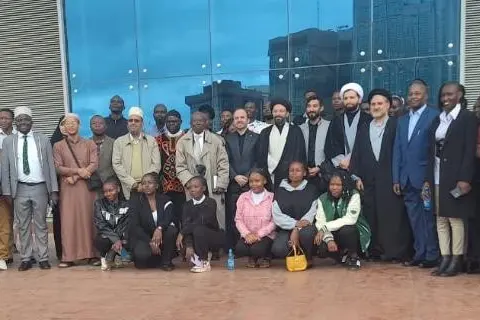
The life of the martyred leader of Iran was a manifestation of justice A professor at the University of Nairobi said: "Even during the days of war, that wise leader was not willing to give himself any advantage over the people, and for this reason, he was martyred in his office. It speaks volumes about the personal courage and justice in the actions of Ayatollah Khamenei (RA).
According to the Public Relations Department of the Islamic Culture and Communications Organization, the University of Nairobi hosted a one-day conference titled "Justice and Human Dignity from the Perspective of Islam and Christianity."
This conference was held in collaboration with the University of Nairobi and the International Institute of Islamic Studies in Qom, and was attended by a group of university professors, religious leaders, researchers, students, and representatives of scientific and civil institutions.
The main objective of this meeting was to examine the concepts of justice and human dignity from the perspectives of Islam and Christianity and the role of religions in facing contemporary social and moral challenges.
Mehdi Beiki, Cultural Counselor of the Embassy of the Islamic Republic of Iran in Kenya, emphasized the importance of dialogue, mutual understanding and cooperation between followers of different religions and said: Despite the extensive scientific and technological advances, millions of people around the world continue to suffer from war, poverty and injustice. Material progress alone does not guarantee peace and prosperity, and lasting peace will only be based on justice, human dignity and moral responsibility.
He referred to the sacrifices of nations in preserving independence, sovereignty and national dignity, and while honoring the memory of the martyrs of the recent attacks against the Islamic Republic of Iran, he noted: The loss of every innocent person, regardless of nationality or religion, is a loss for all of humanity.
Beiki, while calling on the attendees to promote justice, dialogue and peaceful coexistence, stated: The role of universities in educating the future generation, strengthening critical thinking and cultivating ethical leaders is very important.
Referring to the historical background of Tehran-Nairobi relations, Iran's cultural attaché in Kenya mentioned the Shirazi heritage on the coast of Kenya as a symbol of the long-standing ties between Iran and East Africa.
Beki emphasized the development of scientific and cultural cooperation through student exchange, implementation of joint research projects and granting scholarships, and called on young people to play an active role in realizing justice, dialogue and respect for cultural diversity.
Patrick Nyabole, head of the Department of Philosophy and Religious Studies at the University of Nairobi, explained the place of justice in the teachings of the Bible and said: Power should not be the criterion for determining right and wrong, and justice should encompass all areas of human life.
Referring to issues such as health services, environmental protection, new technologies and international relations, Nyabole emphasized the need to observe ethical principles in all these areas and called for countries to adhere to international laws.
Joseph Mbazino Ate, a Catholic priest of the Focolare Movement, presented an article entitled “Justice and Peace from an African Perspective; Islam and Christianity,” examining the capacities of African cultures in promoting human dignity, protecting the environment, and providing for public interests.
He considered faith to be an effective factor in creating peace and reconciliation between religious communities, and emphasized the need to fight corruption, return to moral values, and strengthen the foundation of the family.
In his speech on the topic of “Justice in Islam,” Seyyed Muhaddith, deputy director of the International Institute of Islamic Studies in Qom, also introduced justice as putting everything in its rightful place, drawing on the teachings of the Commander of the Faithful, Imam Ali (AS), and considered it one of the most important conditions for leadership.
Citing verses from the Holy Quran, he introduced justice as one of the main goals of divine religions and emphasized the need for rule of law, meritocracy, economic justice, and social accountability.
Abdulkadir Hashim, a professor of philosophy at the University of Nairobi, in a presentation titled “The Constitution of Medina,” examined the place of this historical document as one of the first constitutional documents in human history.
He described the Constitution of Medina as a successful model in managing cultural and religious diversity and achieving peaceful coexistence between different communities.
Hassan Kinywa, a professor at the University of Nairobi, stated: “A few months ago, the leader of this nation was martyred in the war with America. He was a special follower of Imam Ali (AS). During the days of war, when he was offered to be transferred to safe havens and places of extreme security, he preferred to live like ordinary people and did not give himself any privileges and was not willing to live a different life simply because of his leadership position, which means justice.
He also emphasized in an article titled “The Covenant of Compassion,” the importance of empathy, dialogue, and mutual understanding in the formation of just and peaceful societies, and considered the role of human values in strengthening social solidarity.
Zahra Golzar, a professor at the seminary and university, in an article titled “Human Dignity in Islam and Shiite Literature,” based on verses from the Holy Quran, divided human dignity into two parts: inherent and acquired. While explaining the different dimensions of this concept in Islamic thought, she introduced Imam Hussein (AS) as a symbol of dignity, freedom, and resistance to oppression.
She also pointed to the prospect of realizing global justice in the era of the emergence of the Imam of the Age (AS) and the companionship of Jesus (AS) in establishing global peace and justice.
Professor Nyahele, a professor of philosophy at the University of Nairobi, emphasized the need to focus on common values among Abrahamic religions and respect differences in beliefs, and stated: Successful interfaith dialogue requires a spirit of understanding, cooperation, and avoidance of confrontation.
Karuri Mbugwa, a full professor at the University of Nairobi, called for continued cooperation between universities, religious leaders, and civil society organizations.

Write your comment.