

Publication of the Proceedings of the International Conference on “The Role of Alavi Sayyids in Promoting Peace, Peaceful Coexistence, Arts and Sciences in India”
The publication of the proceedings represents an important stage in completing the scholarly process initiated by the conference. A conference does not conclude with the presentation of papers; transforming presentations and research findings into a published work ensures that these scholarly contributions remain accessible to future generations of researchers. The present volume can serve as a useful resource for scholars working in the fields of Indian history, Islamic studies, the history of Sufism, Persian and Urdu language and literature, art history, manuscript studies and intercultural studies. The publication of such scholarly works also provides an opportunity for comparatively less-explored subjects to enter wider academic discourse and may encourage young researchers to undertake further studies in these areas.
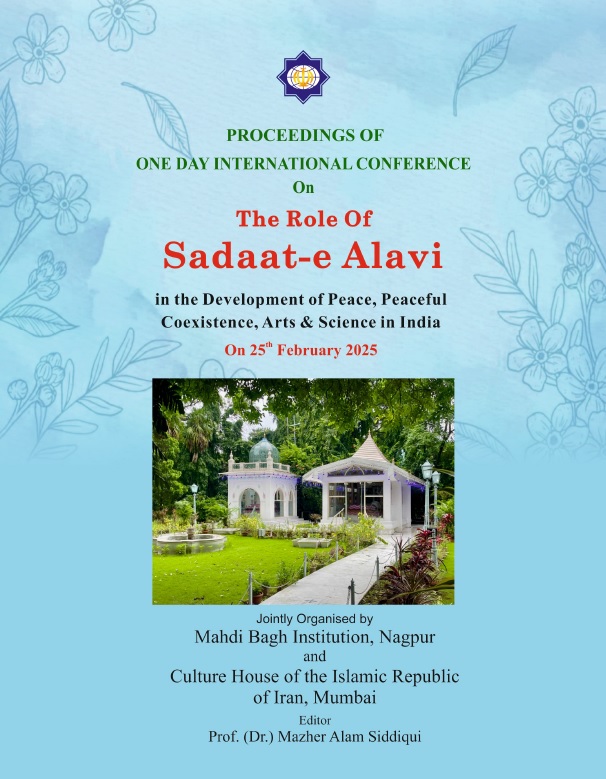
Publication of the Proceedings of the International Conference on “The Role of Alavi Sayyids in Promoting Peace, Peaceful Coexistence, Arts and Sciences in India”
Coinciding with the auspicious birth anniversary of Prophet Muhammad (PBUH) and the commencement of Unity Week, the proceedings of the one-day International Conference on “The Role of Alavi Sayyids in Promoting Peace, Peaceful Coexistence, Arts and Sciences in India” have been published.
The conference was held on 25 February 2025 at the Mehdi Bagh Institute, Nagpur, in collaboration with the Mehdi Bagh Institute and the Iran Culture House, Mumbai. The publication represents a valuable step towards documenting and introducing an important part of the historical, intellectual, cultural and social heritage of the Alavi Sayyids in the Indian subcontinent. Over the centuries, this heritage developed through interaction with the diverse cultures of the region and found expression in areas including knowledge, mysticism, education, literature, calligraphy, art, architecture and social relations.
The volume contains 19 research articles in Persian, Urdu and English, most of which were presented and discussed during the conference. In addition to preserving the scholarly outcomes of the conference, publication of these papers provides researchers and those interested in the history and culture of India with access to a collection of studies concerning the presence and contributions of the Alavi Sayyids in the Indian subcontinent.
Articles in English
The English section includes the following research papers:
-
The Arrival of the Alavi Sayyids in India, Their Expansion and Contributions in Various Fields — Dr. Javed Siddiqui
-
The Life and Works of Shah Ghulam Ali — Dr. Tarnam Begum
-
The Contribution of Maulana Shah Ghulam Ali to the Development of Peace and Peaceful Coexistence in India — Dr. Mazhar Alam Siddiqui
-
The Contribution of the Sayyids in the Modern Era: A Study of the Life and Works of Syed Sadat Hussain Naqvi — Dr. Tariq Rasool
-
Self-Purification: The Key to Reforming the Human Being — Tarnam Naz
-
Kakori: A Settlement of the Alavi Sayyids — Abuzar Hashemi
-
A Brief History of the Alavi Sayyids in India — Dr. Gulrez R. Khan
Articles in Persian and Urdu
The Persian and Urdu sections include:
-
An Introduction to the Manuscript “Mir’at al-Asrar” Associated with the Khuda Bakhsh Library — Dr. Noor Ashraf
-
The Role of Sayyid Calligraphers in the Flourishing of Nastaliq Calligraphy during the Timurid Period — Muhammad Ajmal
-
The Influence of Sufis and the Alavi Sayyids on Social Harmony in India — Dr. Aleem Ashraf Khan
-
The Alavi Sayyids of Achalpur — Dr. Muhammad Yahya Jameel
-
An Important Centre of the Alavi Sayyids: Khanqah Kazimia, Kakori — Ustad Shah Hussain Ahmad
-
Syed Muhammad al-Husayni Gisudaraz — Muhyuddin Ahmad Taj
-
Wahdat al-Wujud in the Letters of Shah Abdul Razzaq Alavi Jehanjanawi — Dr. Syed Sajjad Syed Mushtaq
-
Syed Namdar Salar Masud Ghazi: Life and Works — Dr. Nahid Afroz Suri
-
The Arrival of the Alavi Sayyids in the Indian Subcontinent, with Reference to Shah Dolhar Haman Ghazi — Qazi Syed Shariatuddin
The articles examine the history and contributions of the Alavi Sayyids from a variety of historical, mystical, social, literary and artistic perspectives, presenting a diverse body of research on their presence and role in the Indian subcontinent.
An Interdisciplinary Study of Indian Cultural History
The subject of the conference is particularly significant in view of the multilayered history of India, which has been shaped by the continuous interaction of diverse communities, religions, languages and traditions. Examining the role of communities that contributed to cultural and intellectual interaction can provide a deeper understanding of the social and cultural history of the Indian subcontinent.
The Alavi Sayyids, whose lineage in Islamic tradition is traced to Hazrat Ali ibn Abi Talib (RA) and the family of the Prophet Muhammad (PBUH), entered the Indian subcontinent during different historical periods and settled in various parts of India. Their presence was not confined to religious spheres; a number of them also contributed to scholarship, education, administration, social life, literature and culture.
Professor (Dr.) Mazhar Alam Siddiqui, Scientific Secretary of the conference and editor of the proceedings, has emphasized in the introduction that Indian civilization is the outcome of interaction and participation among diverse communities, cultures and traditions, each of which has contributed to the formation of India's multicultural heritage.
The selection of Mehdi Bagh Institute, Nagpur, as the venue also carried cultural significance. The cooperation of Hazrat Maulana Amiruddin Malik Sahib, President of the Mehdi Bagh Institute, played an important role in facilitating the conference and creating an appropriate environment for scholarly and cultural dialogue.
The conference was attended by researchers from different parts of India, including Bihar, Delhi, Hyderabad and Maharashtra, who presented their research findings. One of the significant academic features of the gathering was the participation of scholars with diverse research backgrounds, creating opportunities for comparison of historical sources, archival documents, oral traditions, literary texts and social studies.
Contributions of Scholars and Cultural Institutions
The conference was the result of the cooperation of a number of researchers, academics and cultural figures. The messages published in the volume acknowledge the contributions of Professor Mazhar Alam Siddiqui, Dr. Gul-Rez Rahman Khan, Dr. Abuzar Hashemi, Dr. Tarnam Begum, Professor Anjum Ziauddin Taj, Mr. Riyaz Lamak and other contributors.
The role of the Mehdi Bagh Institute and the Iran Culture House, Mumbai, in providing the academic and organizational framework for the event has also been acknowledged. Such collaboration is particularly important because cultural and historical research often requires cooperation among academics, cultural institutions, religious centres, libraries and custodians of archival materials.
Significance of the Publication
The publication of the proceedings represents an important stage in completing the scholarly process initiated by the conference. A conference does not conclude with the presentation of papers; transforming presentations and research findings into a published work ensures that these scholarly contributions remain accessible to future generations of researchers.
The present volume can serve as a useful resource for scholars working in the fields of Indian history, Islamic studies, the history of Sufism, Persian and Urdu language and literature, art history, manuscript studies and intercultural studies.
The publication of such scholarly works also provides an opportunity for comparatively less-explored subjects to enter wider academic discourse and may encourage young researchers to undertake further studies in these areas.
The publication of the proceedings thus serves not only as a permanent scholarly record of the International Conference but also as a contribution to the broader study of India's diverse historical, cultural and intellectual heritage.

Write your comment.