

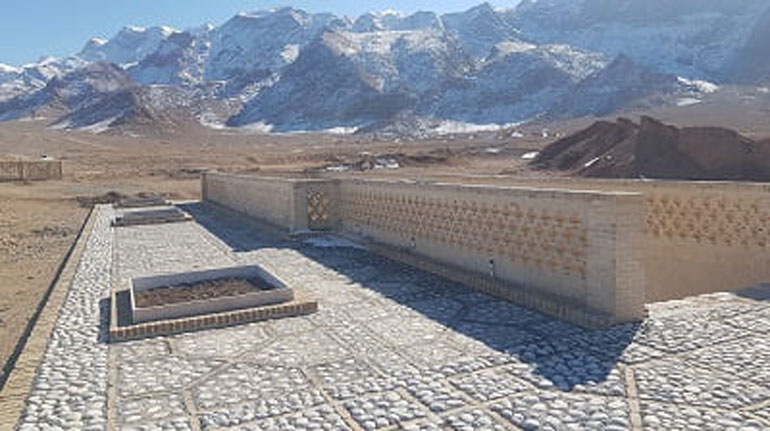
Among the remarkable technological and engineering achievements of ancient Iran, there is one that, unlike magnificent mosques, lavish palaces, and bustling bazaars, operates in complete silence and anonymity deep beneath the earth. That structure is the qanat, also known as a kariz—a sophisticated network of underground channels that carries water from mountain foothills and underground aquifers to the surface, making life possible across the arid Iranian Plateau. A qanat is not merely an engineering structure; it represents a technological innovation in the history of human civilization, a masterpiece of sustainable design, and a social and cultural institution.
The history of qanats in Iran dates back more than three millennia. Living on a dry and water-scarce plateau, ancient Iranians faced a fundamental challenge: how could they bring water from deep underground and from distant mountain foothills to the surface, and then to their fields and settlements, without relying on animal power or mechanical pumps? Their answer to this challenge was the qanat—a technology regarded as one of the most significant hydraulic engineering innovations of the ancient world. Its development played a crucial role in enabling settled life and agriculture across the Iranian Plateau.
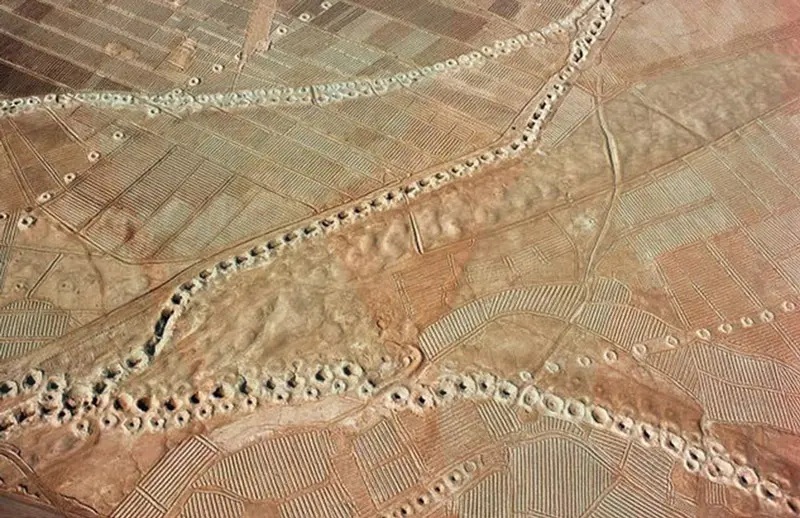
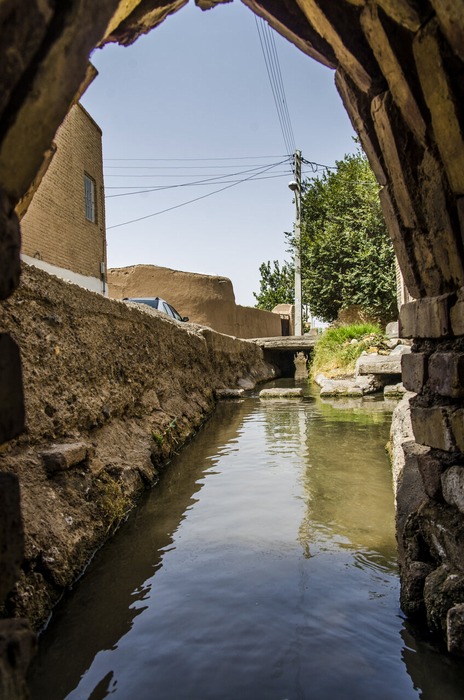
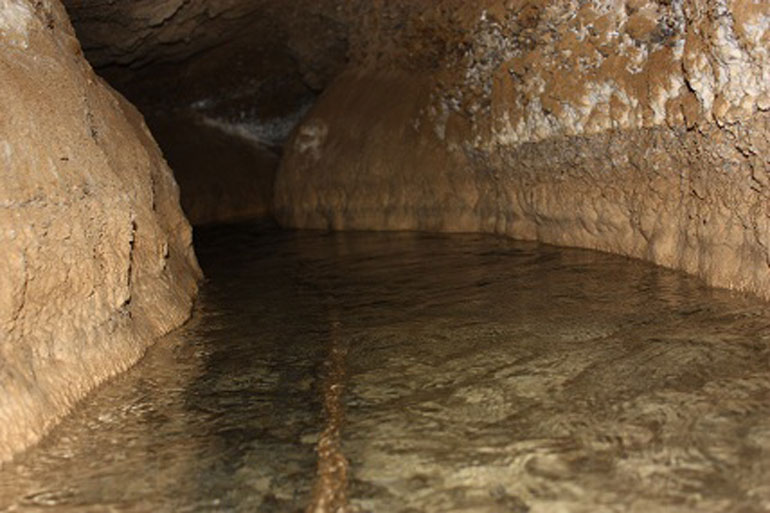
At first glance, the structure of a qanat may seem simple, but in reality, it is a highly sophisticated and precisely engineered system. A qanat consists of several main components: the mother well, the deepest well in the system, which is dug into the foothills near an underground aquifer; the underground tunnel, a gently sloping channel that carries water from the mother well toward the qanat’s outlet; vertical shafts, which are dug at regular intervals along the tunnel to provide ventilation, remove excavated soil, and allow workers to access the underground passage; and the qanat outlet, or mazhar, where, after traveling a long distance underground, the water finally emerges at the surface.
What makes the qanat a remarkable feat of engineering is the precise grading of its tunnel. The slope had to be carefully calculated: on the one hand, it needed to be sufficient for water to flow gently under the force of gravity; on the other, the flow could not be so rapid that it would erode the tunnel walls. Using simple surveying and leveling tools, Iranian qanat builders were able to construct tunnels with carefully calculated, gentle gradients. This remarkable precision, especially in tunnels that sometimes extend for tens of kilometers, reflects the sophisticated practical knowledge developed by qanat builders over generations.
The length of qanats varies greatly depending on the depth of the aquifer and the distance to the outlet. Some qanats are only a few hundred meters long, while others extend for tens of kilometers. The Zarch Qanat in Yazd is the longest recorded qanat in Iran, extending for more than 70 kilometers and featuring more than 2,000 vertical shafts. It stands as one of the remarkable achievements of traditional hydraulic engineering. The depth of mother wells also varies considerably. Some are only about 10 meters deep, while the Qasabeh Qanat in Gonabad has a mother well approximately 200 meters deep. One of its branches, the Doolab-e branch, reaches a remarkable depth of about 300 meters.
A qanat was not merely a water-supply structure; it was a comprehensive water-management system and a complex social institution. Qanat water was distributed among users according to precise traditional systems of water allocation, such as the Tomar system in Yazd. Each farmer, orchard owner, or household was entitled to a specific share of the qanat’s water, measured according to traditional units of time and allocation. These systems enabled precise and equitable water sharing and helped regulate access to this vital resource.
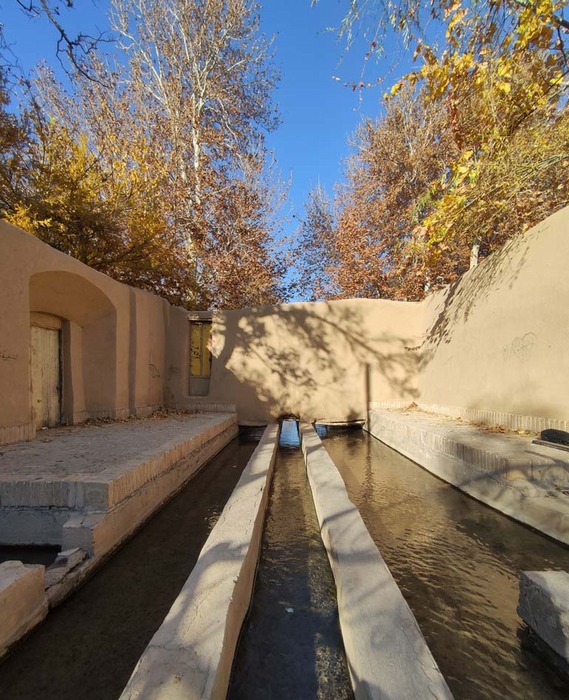
Qanats also had a profound and lasting influence on Iranian architecture and urban planning. Settlements, towns, and villages were traditionally established where qanat water was accessible. The qanat outlet, or mazhar, would typically discharge into a pool or basin, from which the water was channeled to different parts of the settlement. In many desert cities, such as Yazd, Kashan, and Nain, payabs—underground spaces providing access to qanat water—were built into houses, mosques, and bazaars. Reached by stairways descending deep below ground, these spaces provided a cool and pleasant refuge during the hot summer months.
Qanat water was also the lifeblood of the Persian gardens. Magnificent gardens such as Fin Garden in Kashan, Dowlatabad Garden in Yazd, and Shazdeh Garden in Mahan were irrigated by qanat water. The streams, pools, and fountains in these gardens were designed using gravity and differences in elevation, allowing water to flow through them without the need for mechanical pumps. In this way, the qanat brought not only water, but also beauty and vitality to Iranian architecture.
Qanats also influenced the physical structure and urban morphology of Iran’s desert cities. Neighborhoods often developed around qanat outlets, while streets and passageways were influenced by the distribution of water. The location of homes and public spaces was likewise shaped by access to qanat water and the network through which it was distributed.
Beyond its engineering function, the qanat was also a cultural phenomenon. Constructing and maintaining a qanat required extensive knowledge, skill, and courage. The muqannis, or qanat diggers, were highly skilled specialists in traditional Iranian society. Their knowledge, passed down orally from one generation to the next, encompassed a precise understanding of geology, hydrology, tunnel gradients, excavation techniques, and underground ventilation.
Today, with the widespread use of mechanical pumps and deep wells, many qanats across Iran have dried up or fallen into disuse. Yet in some parts of the country, qanats still carry water, and muqannis continue to practice this traditional craft.
Eleven Iranian qanats are inscribed as components of the UNESCO World Heritage property The Persian Qanat: Qasabeh Gonabad, Baladeh, Zarch, Hasan Abad-e Moshir, Ebrahim Abad, Vazvan, Mozd Abad, Qanat of the Moon, Gowhariz, Ghasem Abad, and Akbar Abad. Their inscription on the World Heritage List recognizes the exceptional cultural, technological, and historical significance of this ancient water-management system.
Qanats offer vital lessons in sustainable water-resource management, designing infrastructure in harmony with nature, the importance of traditional knowledge and oral traditions, and the role of water in shaping architecture and urban life.
The qanat reminds us that, in a world facing growing water challenges, some of the answers to today’s questions may lie in the ancient knowledge of our ancestors—a body of knowledge that made life possible in the heart of the desert for thousands of years, while working within the limits of the natural environment and making careful use of scarce water resources.