

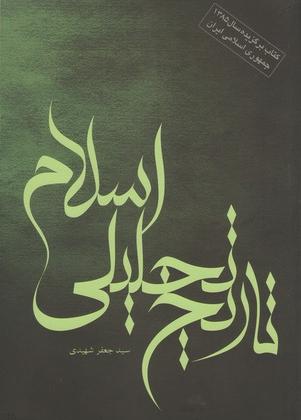
The book Analytical History of Islam provides a descriptive overview and analytical study of the history of early Islam, spanning from the advent of Islam to the first half of the fourth century AH. The author of this book, Seyed Jafar Shahidi, is regarded as one of the most prominent researchers of the Persian language and Islamic history. Scholars in this field consider him the founder of a new school of thought in documenting Islamic history. The late Professor Shahidi began his academic journey with religious studies. In his youth, he studied at the Islamic seminaries of Qom and Najaf, where he was a student of renowned grand ayatollahs such as Ayatollah Borujerdi and Ayatollah Khoei. Later, as a professor at the Faculty of Literature and Human Sciences at the University of Tehran, he advanced his academic career by learning from legendary masters such as Ali-Akbar Dehkhoda and Badiozzaman Forouzanfar. Notably, the late Shahidi’s masterful translation of the Nahj al-Balagha won the Islamic Republic of Iran's Book of the Year Award in 1990.
The Methodology and Scope of "Analytical History of Islam"
Analytical History of Islam is a seminal work that investigates the social and political prerequisites surrounding the advent of Islam. The book offers a comprehensive, analytical account of the life of the Prophet Muhammad (PBUH), his successors, the socio-economic conditions of Muslims, and the major events and transformations within Islamic society from its origins up to the first half of the fourth century AH. Rather than merely chronicling historical events and shifts, the author draws upon credible historical sources to evaluate them through an analytical lens, uncovering the underlying causes of these historical transformations. Written with a sharp, critical perspective, Analytical History of Islam actively challenges and deconstructs widespread yet inaccurate historical myths and misconceptions.
In this book, the author posits that a significant portion of early Islamic historical writings is not actual history, but rather the written recording of folk tales and legends. He categorizes the narrators of certain events—particularly those recounting the early Islamic conquests—as storytellers rather than historians. For instance, he views certain accounts regarding Abd al-Rahman ibn Muljam’s motives for assassinating Imam Ali (AS) as the product of storytellers' fabrications, openly questioning the famous narrative surrounding his infatuation with Quttam. Reflecting its enduring academic significance, the book reached its 44th printing edition in 2019.
A Chapter-by-Chapter Overview
Published by the University Publication Center (Markaz-e Nashr-e Daneshgahi) in 1983, Analytical History of Islam is structured into eight distinct chapters: Chapter 1: Examines the geographical location of the Arabian Peninsula alongside its socio-political conditions prior to the advent of Islam. Chapter 2: Dedicated to the rise of Islam, covering the appointment (Bi'tha) of Prophet Muhammad (PBUH), the conversion of his close associates, the opposition of the pagans, the migration (Hijrah) to Medina, and the changing of the Qibla from Jerusalem to Mecca. Chapter 3: Explores the military campaigns and battles of the Prophet (PBUH) against the polytheists, chronicling major developments up until his passing. Chapter 4: Provides an in-depth study and analysis of the issue of the Caliphate following the Prophet's death. Chapter 5: Deals with the socio-political situation of the Islamic realm after the martyrdom of Imam Ali (AS). Chapters 6 and 7: Review the rise of the Umayyad and Marwanid dynasties and the sweeping historical transformations of those eras. Chapter 8: The final chapter concludes the work by analyzing the downfall of the Umayyads and the subsequent rise of the Abbasid Caliphate to power. International Recognition: The book has also been translated into German by Hela Kamalian under the title Analysierte Islamische Geschichte.
Other Lasting Legacies
The late Seyed Jafar Shahidi’s Persian translation of the Nahj al-Balagha stands out as one of his most enduring and monumental works. What sets his translation apart from others—beyond its accuracy, faithfulness, precision, and meticulous word-for-word alignment between Arabic and Persian—is his profound reverence for the literary features of this immortal text. Shahidi skillfully integrated rhetorical devices and literary embellishments, such as metaphors, similes, wordplay (jinas), parallelism (mowazaneh), literary harmony (mora'at-e nazir), and particularly rhymed prose (saj'). He preserved these elements in the Persian rendering as much as humanly possible, yet he never allowed semantic meaning to be sacrificed for the sake of verbal decoration. This eloquent translation and fluid commentary earned widespread acclaim from scholars and general readers alike.
Another landmark publication by Seyed Jafar Shahidi is the book Mahdaviyat and Islam (Messianism and Islam). In this work, Shahidi actively refuted the theories of Ahmed Kasravi, systematically addressing Kasravi's severe critiques of Shi'ism and Islam. These comprehensive responses have been made available to interested readers in his book titled The Crimes of History (Jenayat-e Tarikh).
A Lasting Legacy Among Immortal Figures
Dr. Seyed Jafar Shahidi passed away on Sunday, January 13, 2008 (23 Dey 1386 SH). Throughout his illustrious career, he was awarded an honorary doctorate from Peking University. In 1995, during his lifetime, Dr. Shahidi received the highest prestigious first-class scientific medal of honor from the President of the Islamic Republic of Iran.