

Iran on the Right Side of History
A member of the Mombasa Executive Committee for Education and Technical and Vocational Training in Nairobi stated: Iran stands on the right side of history; it is the aggrieved party and has the right to self-defense.
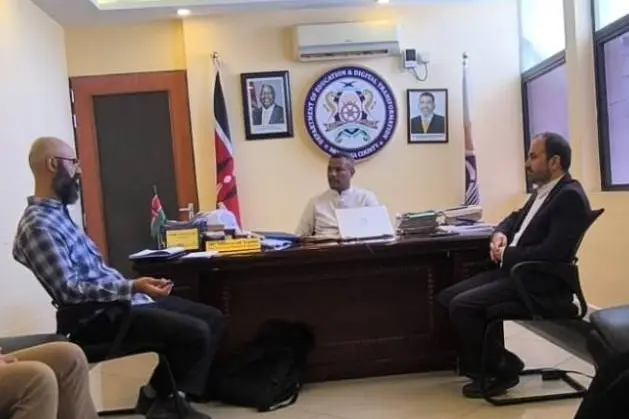
A member of the Mombasa Executive Committee for Education and Technical and Vocational Training in Nairobi stated: "Iran stands on the right side of history; it is the aggrieved party and has the right to self-defense."
The Cultural Counselor of the Islamic Republic of Iran in Nairobi Dr. Mehdi Beiki met with Abu Yasser Mborali Kameh—a member of the Mombasa Executive Committee for Education and Technical and Vocational Training—at his office in the city of Mombasa.
During the meeting, the Kenyan official—while commending the Islamic Republic of Iran’s steadfastness against colonial powers and affirming its right to self-defense—discussed and reached agreements on areas of educational and cultural cooperation. Key topics included teacher training for secular and religious schools, training for Islamic studies and Arabic language teachers, book translation and publication, and the expansion of educational cooperation in Kenya's coastal region.
Emphasizing Iran’s Stature and Expanding Educational Cooperation
In this meeting, Abu Yasser Mborali Kameh expressed appreciation for the Islamic Republic of Iran and its people. Referring to recent developments, he stated: "Iran stands on the right side of history; it is the aggrieved party and has the right to self-defense."
He also commended the resilience and resistance shown by the people and leadership of the Islamic Republic of Iran in the face of foreign pressures and powers, emphasizing the importance of expanding educational and cultural ties with Iran.
The official responsible for education and technical-vocational training in Mombasa outlined his department's activities—including technical and vocational training, the hosting of international Quran competitions, teacher training for secular and religious schools, and the organization of courses for teachers and mosque imams—and welcomed the proposal to hold "train-the-trainer" courses. Referring to the experience of conducting teacher-training courses at the Cultural Center in Nairobi, he called for similar courses to be held in Mombasa for school teachers and emphasized the potential of Kenya’s coastal region to expand such collaborations.
.webp)
Pilot Teacher-Training Course for Religious Schools
Under an agreement reached, a pilot teacher-training course for religious schools and instructors of Islamic religious studies will be held in Mombasa. This course will serve as a pilot project for expanding the program to other counties in the coastal region, including Kwale, Kilifi, and Lamu.
Mohammad Reza Hozourbakhsh, a visiting lecturer at Pwani University, explained the course structure during the meeting, noting that the program is based on two educational textbooks. It covers topics such as Islamic history, the fundamentals of Islamic belief, teaching and learning methodologies, anthropology, the theory of evolution and Darwinism, individual and social ethics, and the issue of identity in non-Muslim environments.
He added that prior to the course's commencement, the participants' proficiency levels and educational needs would be assessed, and the course content would be tailored to the audience.
Project to Translate and Publish Iranian Works in Swahili, English, and Arabic
In another part of the meeting, representatives from Green Palm Publications outlined a project to translate and publish Iranian works in Swahili, English, and Arabic. The initiative aims to provide suitable content for children, families, and Muslim communities across genres such as children's literature, family and lifestyle, and novels.
Representatives from Green Palm Publications also highlighted their participation in over 40 international book fairs and expressed their readiness to offer works at affordable prices, as well as to collaborate with local schools and distributors in Mombasa. It was also decided that, upon the announcement of the dates for the book fair and the annual teachers' conference in Mombasa, arrangements would be made to showcase works from Iranian publishers.
Mombasa’s Potential for Expanding Iran’s Cultural Diplomacy
As one of East Africa’s key cultural, educational, and Islamic hubs—and a gateway to Kenya’s coastal region—Mombasa offers significant potential for expanding the Islamic Republic of Iran’s cultural and educational diplomacy.
Elevating cooperation from mere cultural and academic exchanges to the realm of teacher empowerment and human resource training could establish a more sustainable foundation for Iran’s scholarly and cultural presence in the region.
Furthermore, the warm reception by Mombasa County’s education official regarding the teacher-training programs offered by the International Institute of Islamic Studies (Qom)—coupled with the invitation extended by the Cultural Consulate to attend the international teachers' conference—demonstrates a promising opportunity to transform existing cultural ties into structured, ongoing educational programs.
This meeting was attended by Mohammad Reza Hozourbakhsh (a visiting lecturer at Pwani University) and representatives from Nakhl-e Sabz International Publications (Mohammad Reza Mortazavi and Mostafa Sadeghi). It was conducted within the framework of the Cultural Consulate of the Islamic Republic of Iran’s initiatives to expand cultural and educational diplomacy across Kenya, with the aim of strengthening cooperation with educational and cultural institutions in the country's coastal region.

Nairobi Kenya
Pictures
.webp)
Write your comment.