
Commemoration Day Ceremony of the Demise Anniversary of the Founder of the Islamic Republic of Iran Held in Mumbai under the Title: Yaad e Imam e Rahil R.A (“In Memory of Imam Khomeini (RA)”)
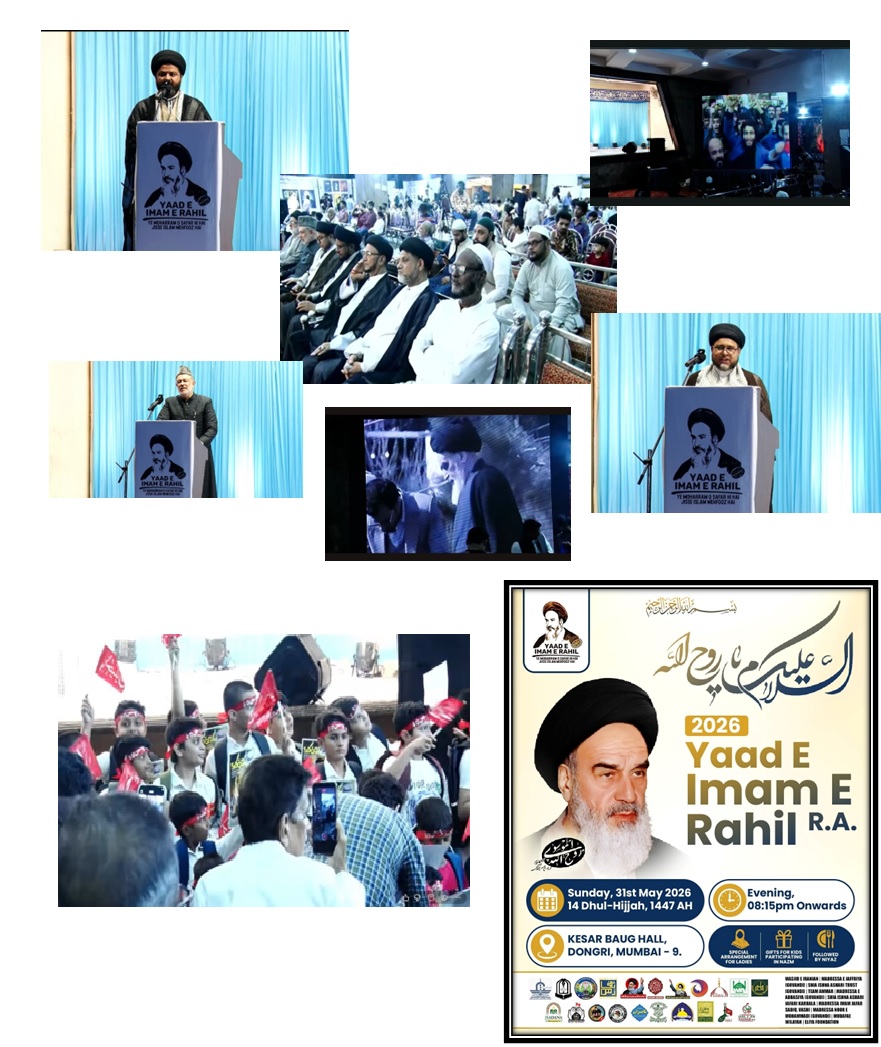
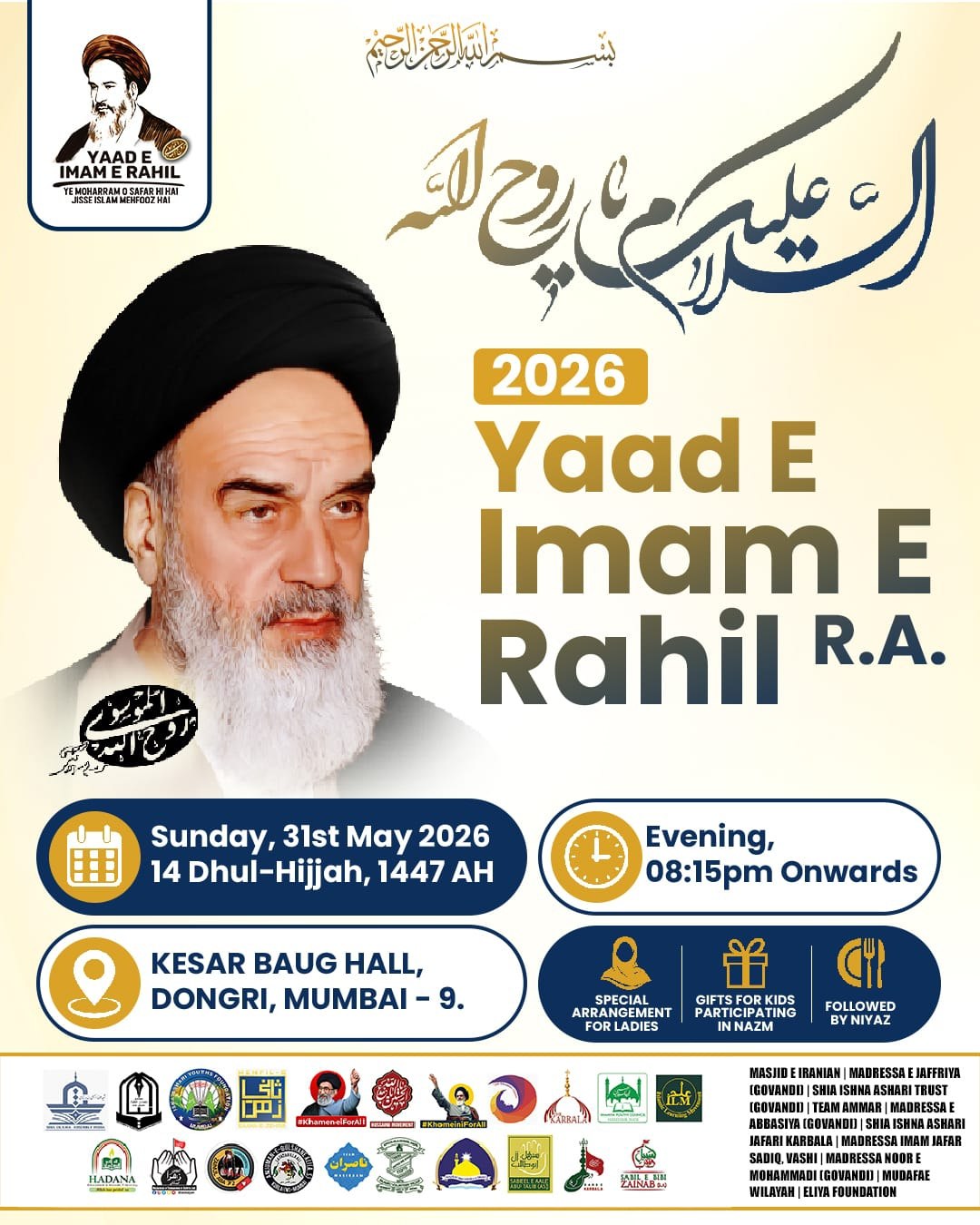
As the anniversary of the passing of the Founder of the Islamic Republic of Iran, Imam Khomeini (RA), approached, and to commemorate the memory of the revered Imam and the martyrs of the imposed war, a special programme titled “In Memory of Imam Khomeini (RA)” was organized in Mumbai. Since this year the occasion coincided with Eid al-Ghadir, the programme was held a few days earlier on Sunday, 31 May 2026 (10 Khordad 1405) at the grand Qaiser Bagh Hall, Mumbai. The ceremony was attended by a large gathering of Islamic scholars, intellectuals, cultural and social personalities, students, youth, members of the Shia community, and followers of the Ahl al-Bayt (AS). The event was held in an atmosphere filled with spirituality, Islamic unity, and respect for religious and human values. In view of the large participation, necessary security and organizational arrangements were made in cooperation with local authorities.
Commemoration Day Ceremony of the Demise Anniversary of the Founder of the Islamic Republic of Iran Held in Mumbai under the Title: Yaad e Imam e Rahil R.A (“In Memory of Imam Khomeini (RA)”)
As the anniversary of the passing of the Founder of the Islamic Republic of Iran, Imam Khomeini (RA), approached, and to commemorate the memory of the revered Imam and the martyrs of the imposed war, a special programme titled “In Memory of Imam Khomeini (RA)” was organized in Mumbai. Since this year the occasion coincided with Eid al-Ghadir, the programme was held a few days earlier on Sunday, 31 May 2026 (10 Khordad 1405) at the grand Qaiser Bagh Hall, Mumbai.
The ceremony was attended by a large gathering of Islamic scholars, intellectuals, cultural and social personalities, students, youth, members of the Shia community, and followers of the Ahl al-Bayt (AS). The event was held in an atmosphere filled with spirituality, Islamic unity, and respect for religious and human values. In view of the large participation, necessary security and organizational arrangements were made in cooperation with local authorities.
The programme began with the recitation of verses from the Holy Quran. The first speaker highlighted the simple lifestyle and spiritual qualities of Imam Khomeini (RA), the martyrs, and his devoted companions. He explained the significance of the Hadith of Thaqalayn, referring to the Prophet Muhammad’s (PBUH) guidance regarding adherence to the Holy Quran and the Ahl al-Bayt (AS) as the two precious trusts of the Muslim Ummah. He emphasized their role as sources of guidance and preservation of Islamic identity.
Addressing contemporary developments in the Muslim world, the speaker stated that many nations and freedom-seeking communities have become increasingly aware of the consequences of colonialism, domination, and policies based on force. He further referred to the message of the Supreme Leader of the Islamic Republic of Iran on the occasion of Hajj, emphasizing the importance of Hajj as a symbol of unity among Muslims and a platform for intellectual and cultural exchange among the followers of Islam worldwide.
During another segment of the programme, Hojjat al-Islam wal-Muslimeen Syed Meraj Nabi, a prominent poet and orator, presented poetry in praise of the personality of Imam Khomeini (RA), the ideals of the Islamic Revolution, and the role of leadership in guiding the Muslim community. His recitation was warmly received by the audience.
Following this, Dr. Mujahid Hussain, an Islamic scholar and researcher from Hyderabad, delivered a speech discussing various dimensions of Imam Khomeini’s intellectual, spiritual, and social personality. He reviewed the global intellectual and social conditions before the victory of the Islamic Revolution and noted that during that period many Western thinkers considered religion to be declining and believed that modernity would completely replace religious values.
He stated that the victory of the Islamic Revolution of Iran challenged many such assumptions and demonstrated that religion could continue to play an influential role in social and political life. According to him, the Islamic Revolution was not only a political transformation but also a revival of religious, cultural, and civilizational identity in the Muslim world.
Dr. Mujahid Hussain also highlighted the contribution of Imam Khomeini’s students and companions in the fields of education, culture, science, and governance, stating that various scientific, technological, and educational developments in contemporary Iran have been supported by confidence in domestic capabilities and human resources.
He further explained that from the perspective of political studies and sociology of religion, Imam Khomeini (RA) is regarded by many scholars as one of the influential figures of the twentieth century. Researchers across the world continue to study his ideas in the fields of jurisprudence, philosophy, spirituality, politics, and Islamic thought. Many scholars view the Islamic Revolution as an event with significant cultural and identity-related impacts, bringing renewed discussions about the role of religion, independence, social justice, and cultural values in modern societies.
The speaker also referred to Iran’s achievements in areas such as higher education, medicine, technology, and knowledge-based industries, describing them as developments associated by many analysts with increased emphasis on self-reliance and investment in human potential.
During the programme, a documentary film highlighting the life and struggles of Imam Khomeini (RA), the formation of the Islamic Revolution, and scenes from the resilience of the Iranian people during the war period was screened. The documentary was appreciated by the attendees.
Other speakers in the concluding sessions discussed different aspects of Imam Khomeini’s personality, the importance of preserving religious values, and the role of resistance culture in Islamic societies.
At the end of the ceremony, the children’s choir performed the song “Salam Farmandeh,” which was warmly welcomed by the audience.
The gathering concluded in an atmosphere of respect, spirituality, and unity. Participants paid tribute to the memory of Imam Khomeini (RA) and emphasized the importance of continuing cultural dialogue, preserving the intellectual and spiritual legacy of great personalities, and strengthening unity and solidarity among Muslim communities.
The recorded programme can be accessed at:https://www.youtube.com/live/J0uD2Y3PGzM

بمبئی هند
Pictures
Write your comment.