
University of Mumbai Launches Specialized Online Certificate Courses in Numismatics and Reading of Persian Historical Documents: A Step Towards Preserving the Shared Written Heritage of Iran and India
India is home to one of the world's richest collections of Persian manuscripts, historical documents, and written heritage. For more than eight centuries, Persian served not only as the language of literature and culture but also as the official language of administration, governance, judiciary, commerce, diplomacy, and state affairs across large parts of the Indian subcontinent. Today, hundreds of thousands of royal decrees, endowment deeds, legal documents, administrative correspondence, inscriptions, seals, and historical coins preserved in India's libraries, museums, and archives are written in Persian, forming an integral part of the country's historical and civilizational legacy.
India is home to one of the world's richest collections of Persian manuscripts, historical documents, and written heritage. For more than eight centuries, Persian served not only as the language of literature and culture but also as the official language of administration, governance, judiciary, commerce, diplomacy, and state affairs across large parts of the Indian subcontinent. Today, hundreds of thousands of royal decrees, endowment deeds, legal documents, administrative correspondence, inscriptions, seals, and historical coins preserved in India's libraries, museums, and archives are written in Persian, forming an integral part of the country's historical and civilizational legacy.
The study of the Persian language and literature provides an essential gateway to understanding India's history, legal traditions, economy, art, culture, and civilization. Among the most important interdisciplinary fields connected with Persian are numismatics and the study of historical documents. Historical coins provide valuable evidence religious beliefs, artistic traditions, calligraphy, minting practices, historical geography. Likewise, Persian archival documents offer unparalleled insights into the administrative structure, social institutions, and cultural life of India across different historical periods.
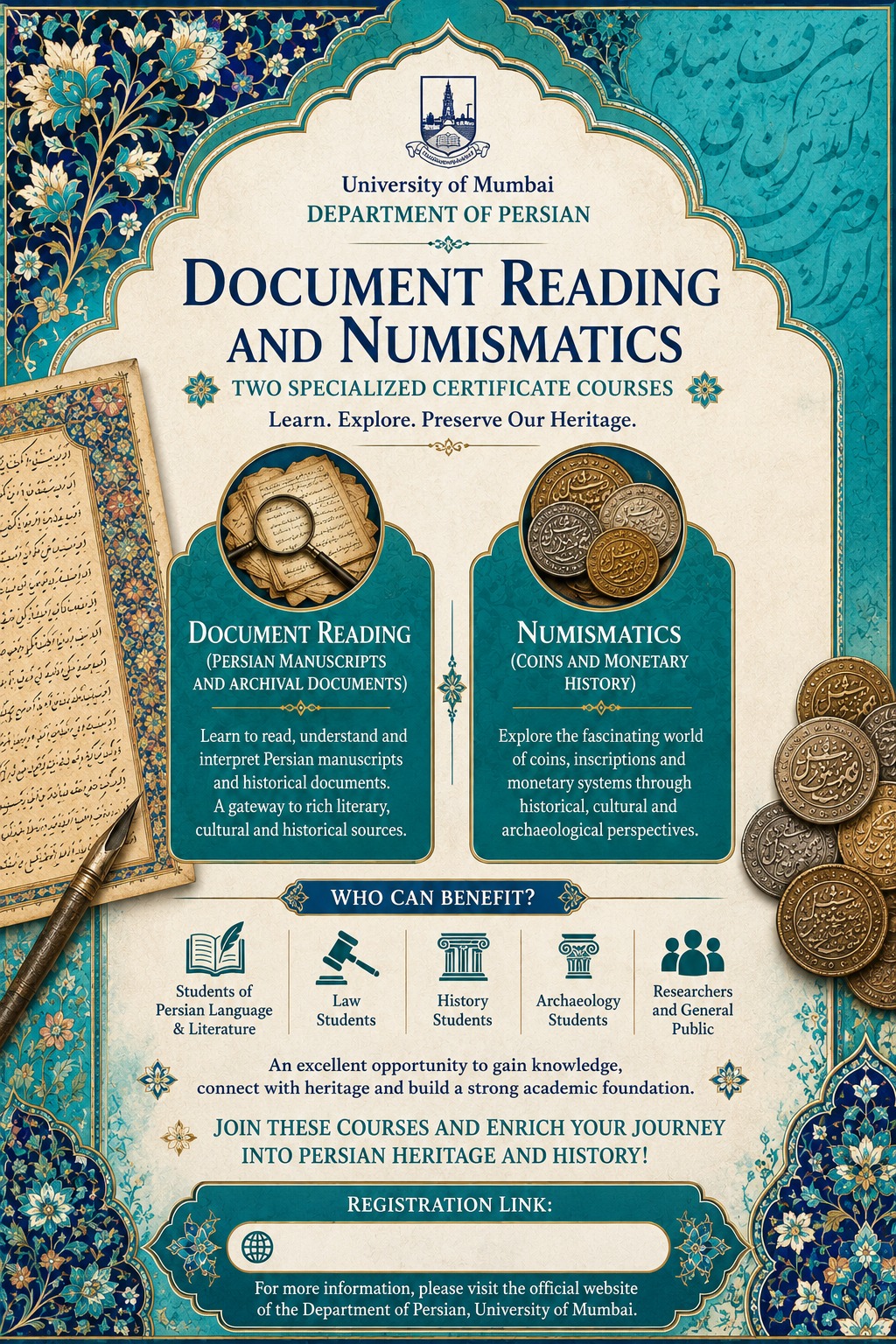
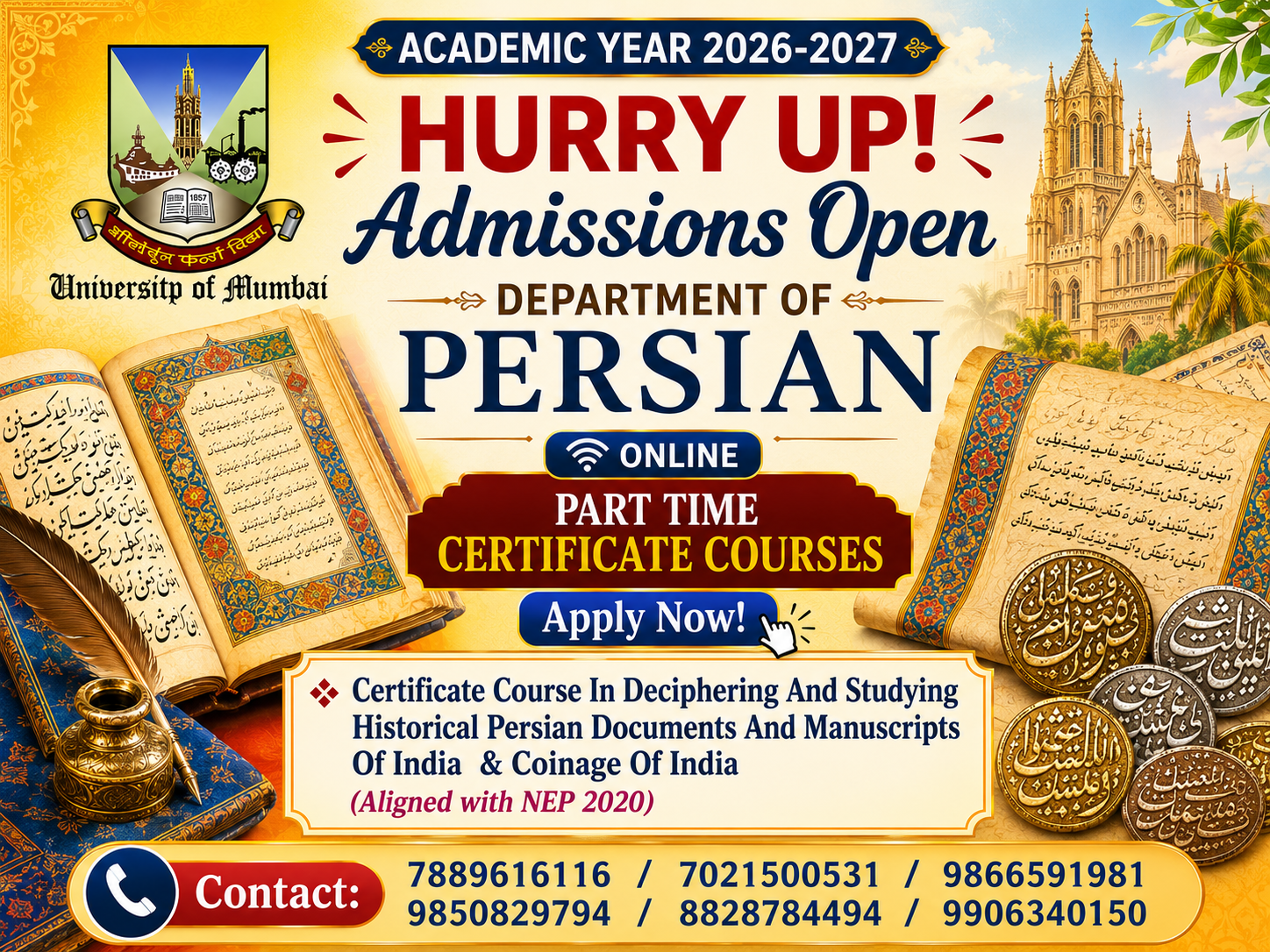
Recognizing the academic importance of these fields, the Department of Persian, University of Mumbai, under the guidence of Dr. Sakina Imtiaz Khan, has launched two specialized online certificate courses: Numismatics and Reading of Persian Historical Documents. These programmes have been designed to train a new generation of researchers and specialists in these important fields.
The courses have attracted enthusiastic participation from students and scholars of Persian language and literature, history, archaeology, law, museum studies, archival studies, Islamic studies, Iranian studies, and heritage conservation. In addition to participants from various states across India, researchers and enthusiasts from several other countries have also enrolled, taking advantage of the online format.
The Certificate Course in Reading of Persian Historical Documents is taught by Mr. Nikhil Paranjpe, a distinguished researcher specializing in India's historical archives. The course introduces participants to various Persian scripts and paleographic styles, legal and administrative terminology, the structure of royal decrees, property documents, judicial records, and official correspondence. Participants will develop the practical skills required to read, analyse, interpret, and document these valuable historical sources.
The Certificate Course in Numismatics is conducted by Mr. Nikhil Dixit, a renowned scholar of Indian economic history and numismatics. Drawing upon his extensive experience in studying and classifying historical coins and his expertise in Persian, he will train participants in the scientific methods of coin identification, interpretation of Persian inscriptions, royal titulature, mint identification, dating of coins, and evaluation of their historical significance. Mr. Dixit has previously undertaken academic visits to the Islamic Republic of Iran, where he explored museums, archaeological sites, and research institutions while expanding his studies on the shared heritage of Iran and India.
One of the distinctive features of these programmes is the close collaboration between the Department of Persian, University of Mumbai, and the Cultural House of the Islamic Republic of Iran in Mumbai. Following a recent meeting between the officials of the Cultural House and Dr. Sakina Imtiaz Khan, the Cultural House donated a set of educational numismatic kits containing carefully reproduced historical coins accompanied by scholarly notes and explanatory material. These teaching resources will enable students to complement theoretical instruction with practical observation and hands-on analysis, thereby gaining a deeper understanding of historical coinage.
The programmes will run for four and a half months and will be conducted entirely online. The curriculum includes lectures, specialized workshops, analysis of authentic historical documents and coins, independent research projects, and scholarly presentations. Upon successful completion of the written and oral examinations, as well as the submission of a research paper, participants will be awarded an official certificate from the University of Mumbai.
The courses are scheduled to commence in the third week of July.
The launch of these specialized programmes represents far more than an academic initiative; it is a significant investment in preserving and revitalizing the shared cultural and documentary heritage of Iran and India. By training scholars capable of applying Persian language skills to historical research, archaeology, museum studies, and archival science, these programmes will contribute to the identification, preservation, and publication of thousands of invaluable historical sources that have the potential to reveal new dimensions of the history and civilization of both nations.
In this broader perspective, the teaching of Persian language together with specialized skills such as historical document reading and numismatics is not only an academic necessity but also a cultural responsibility in safeguarding one of the world's richest written heritages.
Registration
Interested applicants may register online by visiting:

بمبئی هند
Pictures
Write your comment.