

_2.jpg)
_1.jpg)
_2.jpg)
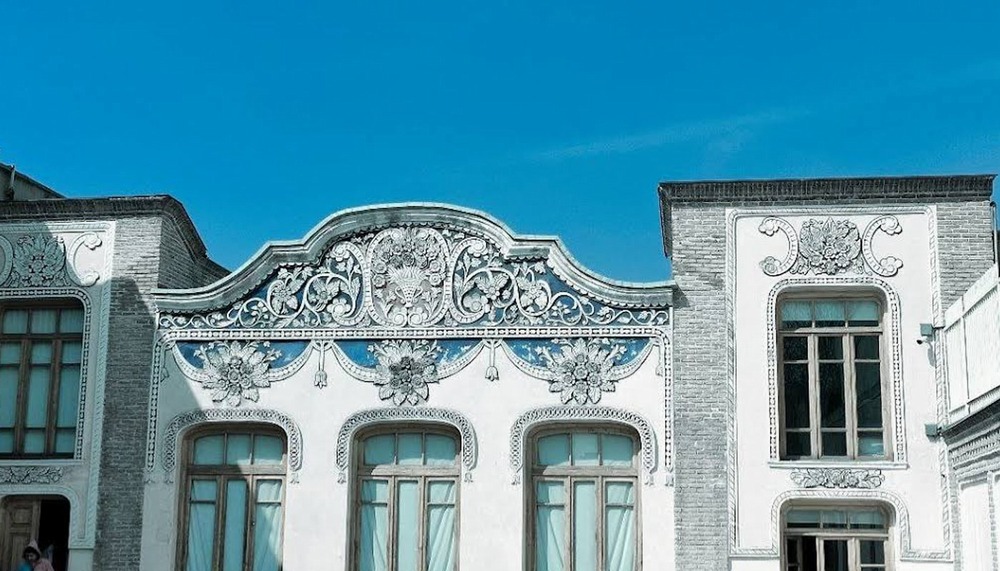
In the historic fabric of Tabriz, tucked away on a narrow, quiet alley behind the Grand Bazaar and next to the Blue Mosque, stands a house that holds a hidden and lesser-known treasure of Qajar-era mural painting. Built in the late Qajar period, around 1290 AH (1911–1912 CE), by Haj Mohammad-Taqi Hariri, one of Tabriz’s wealthy and art-loving merchants, Hariri House appears at first glance much like many other Qajar-era residences in Tabriz, with its central courtyard, columned verandas, orosi windows, and plasterwork decorations. Yet what makes this house truly unique and exceptional is its stunning and diverse collection of murals, covering the walls of its halls, rooms, and verandas and transforming the residence into a true “Museum of Qajar Painting.”
During the Qajar period, Tabriz held a unique position as the residence of the Qajar crown prince and a gateway through which modernity entered Iran. Located along the routes connecting Iran with Russia, the Ottoman Empire, and Europe, the city encountered Western ideas, goods, and art earlier than many other Iranian cities. This cultural exchange was reflected in its architecture and decorative arts as well.
Hariri House is a remarkable expression of this “cultural cosmopolitanism,” blending Iranian traditions with European influences. Haj Mohammad-Taqi Hariri, himself a prominent and well-traveled merchant of Tabriz, drew inspiration from what he had encountered during his travels to Istanbul, Tbilisi, and Moscow. He invited local artists and painters to transform his home into a vast canvas on which to tell the stories, myths, and dreams that had inspired him.
The murals of Hariri House, unlike the more conventional Qajar-era paintings, which were often limited to floral motifs, bird-and-flower compositions, feasting and hunting scenes, and natural landscapes, feature an exceptionally diverse and surprising range of themes.
Within the house, one can find scenes from the epic stories of Ferdowsi’s Shahnameh alongside scenes from the Bible and depictions of the Virgin Mary and Christ; European landscapes featuring churches and stone bridges; depictions of Shi’a religious figures; as well as scenes of dancing, music, and feasting. This remarkable diversity and multiplicity of themes reflects the open-minded, curious, and cosmopolitan spirit of both the homeowner and the artists who created the murals.
In one of the main rooms of the house, scenes from the stories of the Shahnameh are brought to life in vivid, dynamic, and brilliant colors. The battle between Rostam and Sohrab, Rostam’s battle with the White Demon, and scenes from the courts of Kay Khosrow and Kay Kavus are depicted in meticulous detail, with particular attention to the design of the clothing, weapons, and facial features. In another room, a royal hunting scene unfolds, featuring well-bred horses, hunting dogs, and hunters dressed in Qajar-era attire. Along a narrow corridor, landscapes of European villages and churches are depicted, with pointed towers and stone bridges, apparently modeled on postcards and printed images of Europe that were being brought to Tabriz at the time.
Yet perhaps the boldest and most surprising paintings in Hariri House are its Christian religious scenes. One hall features an image of the Virgin Mary and the infant Jesus, while another corner features a depiction of the Last Supper with the Apostles. These paintings stand alongside Shi’a religious imagery, including depictions of the Battle of Karbala and the Imams, presenting a remarkable and peaceful coexistence of different religions and cultures within a private home. This visual coexistence reflects the tolerant, open, and cosmopolitan character of Tabriz during the Qajar period—a city where Muslims, Christians, Armenians, and Jews lived and traded alongside one another for centuries.
The iwans of Hariri House, with their tall, slender, elegant columns and decorative plaster capitals, exemplify the fusion of Iranian architecture with Russian and Caucasian influences that was widespread in Qajar-era Tabriz. These iwans are adorned with deeply carved, intricate plasterwork, murals featuring flower-and-bird and arabesque motifs, and delicate mirrorwork, creating pleasant, shaded semi-open spaces for sitting, relaxing, and enjoying the coolness of the courtyard on summer evenings. The columns of the iwans are decorated with spiral motifs and vertical fluting, while the capitals are embellished with plasterwork featuring floral and arabesque designs.
Unlike the large and expansive courtyards of the historic houses of Kashan, the central courtyard of Hariri House has a compact, intimate, and informal character. A rectangular pool of clear water lies at the center, surrounded by gardens filled with fruit trees, geraniums, jasmine, and boxwood shrubs, creating a lush and charming setting. The courtyard feels more like a warm and intimate “family space” than a formal and ceremonial courtyard. The simple yet precise brickwork of the courtyard walls, complemented by murals in some areas, creates a harmonious and visually pleasing composition.
The main hall, or “Shahneshin,” is located on the northern side of the courtyard, with large, tall orosi windows fitted with colored glass that filter soft, multicolored light into the space. The ceiling of the hall is adorned with deeply carved plasterwork and murals featuring arabesque and geometric motifs, with a “kolah farangi,” or central skylight, at its center. The walls of the hall are likewise covered with a variety of murals and delicate plasterwork.
Today, following expert restoration, Hariri House serves as a museum and art gallery, welcoming tourists and enthusiasts of art and architecture. Visitors can explore this remarkable collection of Qajar-era paintings up close and enjoy the remarkable fusion of Iranian and European art within a historic house.
With its “fusion of art and architecture,” “cosmopolitan character and openness to cultural influences in design,” and “emphasis on mural painting as a narrative medium within a residential space,” Hariri House is a remarkable example of a Qajar-era residence. It demonstrates how a residential building can become a “narrator” and “storyteller,” inscribing the stories, beliefs, dreams, and cultural exchanges of an era onto its very walls. With its diverse and remarkable murals, Hariri House stands as a symbol of Tabriz’s open-minded, curious, and tolerant spirit on the threshold of modernity.