

_2.jpg)
_1_2.jpg)
_2.jpg)
_1_2.jpg)
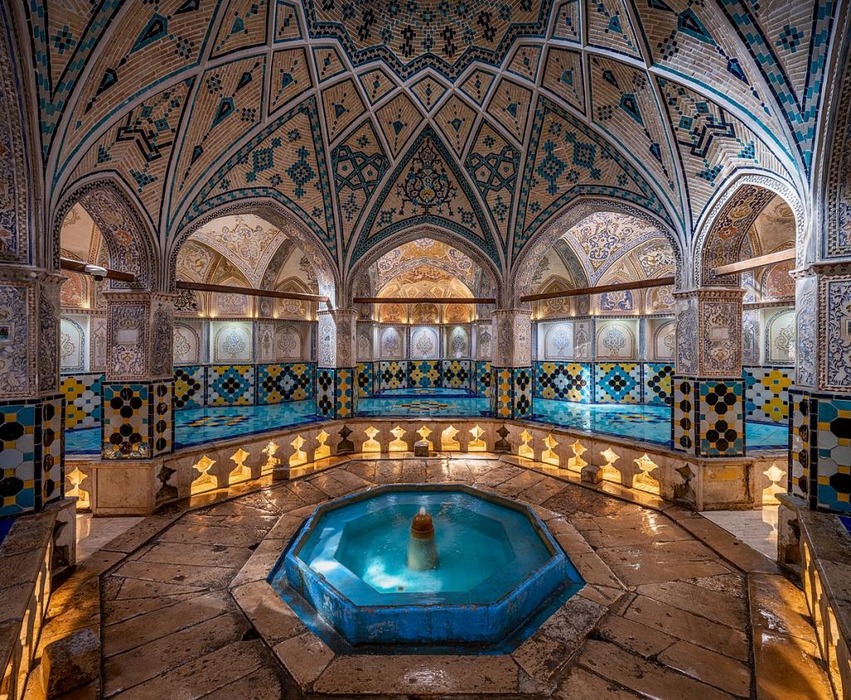
What comes to mind when you hear the word bathhouse? Most likely, you imagine a tiled room with warm water, steam, and soap. Yet the traditional bathhouses of Iran were something far more profound. They were not merely places for cleansing the body, but social institutions with unwritten rules, sophisticated architecture, and customs that accompanied people throughout every stage of life—from childhood to old age. Visiting the bathhouse was not an occasional leisure activity; it was an integral part of the rhythm of weekly life.
In ancient Iran, water held a sacred place. In the Zoroastrian faith, preserving the purity of water, earth, and fire was considered a religious obligation. Yet this reverence did not prevent the construction of public bathhouses. During the Sasanian period, cities were equipped with bathhouses that employed underfloor heating systems (hypocausts)—the same technology famously used in the Roman world. Few physical remains from that era have survived, however.
The bathhouses that can be seen across Iran today belong primarily to the Islamic period, especially from the 10th century onward. Like many other forms of Persian architecture, the construction of bathhouses reached its greatest flourishing during the Safavid and later the Qajar eras, when they evolved into sophisticated architectural and social spaces at the heart of urban life.
Now, let us step inside a traditional Persian bathhouse—not as tourists, but as ordinary townspeople preparing to cleanse ourselves before the Friday prayers. The experience begins long before reaching the warm water. Entering a bathhouse followed a carefully designed sequence, both architectural and ritual, in which every space had a distinct purpose and guided visitors gradually from the outside world into an environment of warmth, purification, and calm.
As you step through the entrance, you first arrive at the sarbineh—the changing hall. This spacious, domed chamber is illuminated by skylights set into the roof, with a raised central platform at its heart. The sarbineh served as a place to change clothes, but its role extended far beyond that. It was a social gathering space where people conversed, drank tea, smoked water pipes, concluded business deals, and even arranged marriage agreements. Visitors often spent hours here. Rich and poor sat side by side; the distinction lay only in where they sat. Raised platforms were reserved for respected elders and wealthy patrons, while everyone else gathered on the simpler benches surrounding the hall.
Beyond the sarbineh, a short, winding passage leads to the garmkhaneh, the hot chamber. This corridor was deliberately designed to prevent cold air from entering the bathing area while keeping the warm air from escaping too quickly. Inside the garmkhaneh, a large central pool was surrounded by stone or marble platforms. Above, a domed ceiling with carefully placed openings diffused daylight into a soft, gentle glow rather than a harsh glare.
The temperature was typically maintained between 30 and 40°C (86–104°F), with high humidity filling the air. Beads of perspiration quickly formed and ran down your face. This was the heart of the bathhouse, where bathing and cleansing took place. Visitors scrubbed their skin with a kiseh (exfoliating mitt), enjoyed vigorous massages, and washed their hair. Professional bath attendants, known as dallaks, worked here—strong men whose craft was often passed down from father to son over generations.
Yet the garmkhaneh was far more than a pool surrounded by stone platforms. Beneath its floor lay an ingenious engineering system. Hidden below was a furnace known as the takhteh-dun, where fires were kept burning continuously. The heat traveled through hollow spaces beneath the stone floor, warming the chamber from below, while smoke was carried away through flues concealed within the walls.
This heating system closely resembled the Roman hypocaust, yet it was constructed using local materials and refined through generations of Persian craftsmanship. If a floor tile were ever removed, the network of channels beneath could be seen—passageways through which hot air and smoke circulated.
What is truly remarkable is that, despite the fire burning underneath, the floor never felt unbearably hot. The distance between the furnace and the floor, together with the carefully calculated thickness of the stone slabs, allowed only a gentle, comfortable warmth to reach the surface. It was a sophisticated feat of engineering, designed not to scorch the feet, but to create an even and pleasant heat throughout the bathhouse.
Hot water was supplied by large copper boilers, known as bath boilers, positioned directly above the furnace. Cold water, drawn from a qanat or well, was first collected in a reservoir located on the roof or in the basement. It then flowed through clay pipes into the boiler, where it was heated before being carried by copper or ceramic pipes to the hot-water pool of the bathhouse. The water emerging from the boiler was carefully regulated—warm enough for comfort, yet never hot enough to burn the skin. Persian architects controlled the water temperature by adjusting the distance between the boiler and the fire, as well as the rate of water circulation. Every aspect of this system relied on precise engineering and Now, let us return to the bathhouse itself. Beyond the shared platforms of the hot chamber, some bathhouses also featured small private rooms known as khalvat (secluded chambers). These spaces were reserved for wealthy families or for those who preferred greater privacy. Separate from the main changing hall, each khalvat had its own entrance and a door that could be locked from the inside.
Many bathhouses were also designed with separate sections for men and women. In others, where a physical division was not possible, different hours of the day were assigned to each gender. Smaller bathhouses followed a simple but effective custom: a flag was raised on the roof to indicate that the bathhouse was reserved for women, and lowered when it was open to men.
Visiting the bathhouse was never just about washing. On the eve of Chaharshanbe Suri, people would go to the bathhouse to prepare for the New Year festivities. Before a wedding, the bride and groom each took part in their own ceremonial bath. After childbirth, new mothers were also brought to the bathhouse as part of their recovery and purification. In traditional Persian life, the bathhouse accompanied every stage of life—from the cradle to the grave.
Persian bathhouses were far from plain. Their interiors were adorned with intricate mosaic tilework, delicate floral motifs, murals inspired by the epic tales of the Shahnameh, polished pink marble, and brilliantly glazed bricks. Why lavish so much beauty on a place where people came to bathe? Because a bathhouse was never merely a public facility—it was an integral part of the city's identity.
Building a bathhouse was regarded as an act of charity, much like building a mosque. Wealthy patrons, philanthropists, rulers, and ministers commissioned bathhouses not only to serve the public, but also to leave behind a lasting legacy. Inscriptions above the entrance often recorded the name of the founder and the date of construction. Some bathhouses, such as the Khan Bathhouse in Yazd and the Ganjali Khan Bathhouse in Kerman, are so exquisitely preserved that they continue to inspire awe to this day.
But with the arrival of modern plumbing and private bathrooms in the late Qajar period and the early Pahlavi era, the age of the public bathhouse gradually came to an end. There was no longer any need to visit a communal bath each week. Hot water was now available at home, and modern urban sewage systems transformed daily life. Bath attendants lost their livelihoods, the sarbineh fell silent, and the once-warm garmkhaneh grew cold.
Many bathhouses were demolished. Others were converted into warehouses or shops. A fortunate few have survived to the present day—but the pools that once reflected light and echoed with conversation now stand dry and still.
Since the late 1990s, a nationwide effort has been underway to restore Iran's historic bathhouses. Today, many of these remarkable buildings have been given new life as museums, traditional teahouses, art galleries, and even restaurants. The Vakil Bathhouse in Shiraz, the Shahzadeh Bathhouse in Isfahan, and the Four Seasons Bathhouse in Arak each stand as examples of how these historic spaces have found new purpose.
In some of them—such as the Khan Bathhouse in Yazd—you can still see the marble floors, worn smooth and polished by the footsteps of millions over the centuries. Sit there in silence, and you may almost hear the gentle drip of water falling from the domed ceiling—echoes repeated for generations, now faded into silence.
Persian bathhouses tell the story of Iranian architecture—not only as places of cleanliness, but as spaces of health, conversation, and respite from the hardships of everyday life. With nothing more than fire, water, stone, and brick, Persian architects created places that offered both comfort and dignity. Today, visiting a bathhouse is no longer a cherished ritual. But perhaps these quiet, empty halls still remind us of a timeless truth: that cleansing the body could also become a way of cleansing the soul.