
From Iran s literary past, a narrative of the flourishing of Iranian culture in past centuries.
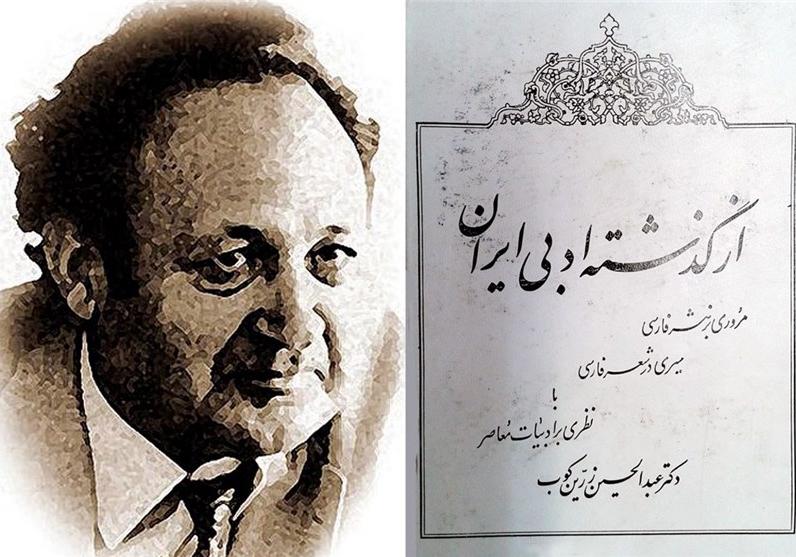
It is often said that the works of Dr. Abdolhossein Zarrinkoub are characterized by nested sentences and are saturated with unfamiliar terms and idioms; consequently, his writings do not easily appeal to those seeking simplicity. Zarrinkoub is regarded as a preeminent man of letters, historian, Islamic scholar, and Iranologist. In his numerous works within the field of literary criticism, he interpreted and analyzed the sublime concepts found in the masterpieces of giants such as Hafez, Rumi, Nezami Ganjavi, and Khaqani, maintaining a scholarly and critical perspective toward Iran’s literary heritage. He left behind a vast bibliography, including: With the Caravan of Hilla (Ba Karevan-e Holleh), From the Alley of the Libertines (Az Kooche-ye Rendan), Step by Step until the Visitation of God (Peleh Peleh ta Molaghat-e Khoda), The Sage of Ganja (Pir-e Ganjeh), In Search of Nowhere (Dar Jostojoo-ye Nakojabad),The Book of Renown (Namvar Nameh), Two Centuries of Silence (Do Gharn Sokoot), The History of People of Iran (Tarikh-e Mardom-e Iran), The Dawn of Islam (Bamdad-e Eslam), History in the Balance (Tarikh dar Tarazoo).
Abdolhossein Zarrinkoub was a thinker who summoned the entire treasury of the Persian language—both ancient and modern—to express the findings of his mind. He had no reservations about employing archaic structures alongside contemporary themes. For this reason, his works remain free from the common linguistic calques (loan translations) of other languages, possessing a truly authentic Persian character.
Iran's Literary Past
The book "Persian Literary Heritage" (Az Gozashte-ye Adabi-ye Iran), authored by Dr. Abdolhossein Zarrinkoub, offers a comprehensive review of Persian prose and a journey through Persian poetry, while providing insights into contemporary literature. Within this work, the transformations of verse and prose are examined in two distinct sections, as the author seeks not only to analyze the evolutionary process of Persian literature but also to depict the flourishing of Iranian culture throughout past centuries. This book consists of a collection of Dr. Zarrinkoub’s notes organized into 92 sections, serving as an invaluable resource for gaining familiarity with the history of Iranian poetry and prose.
The author’s summary and conclusion of the book state that in the evolution of both poetry and prose, factors beyond the political, social, and economic conditions of each era have played a significant role; these include the inherited traditions of each culture and the reflection of often repressed or censored desires and emotions from the past, which have been preserved over centuries within the collective unconscious of generations. These suppressed feelings and longings have found an opportunity to manifest during the evolutionary path whenever necessary or when a chance arose, whether in the form of a "return" to the past or as a "modernity" that was often accepted with great difficulty by the people of that time.
Although this book examines Iran's literary past and takes the form of a literary history, it does not strictly fit within those conventional frameworks, as it goes beyond the boundaries of literary history to identify the causes and factors that influenced the emergence of Iran’s cultural heritage. The final section of the book focuses on contemporary literature, specifically covering figures who have already passed away. The author believes that reviewing Iran's past serves as an introduction to today's literature and a benchmark for evaluating the degree of harmony between the current generation's culture and the requirements of our contemporary era.
Close Bond with the Humanities
Dr. Abdolhossein Zarrinkoub possessed a profound understanding of the nature of Western culture and civilization on one hand, and a complete mastery of Iranian culture on the other. This dual perspective lent a sense of comprehensiveness to his insights and expressions, motivating him to contemplate how modern Iranian culture—which is essentially a blend of traditional heritage and Western influence—could be organized and harmonized. In many of his lectures and articles, he addressed themes such as Westernization versus Western-avoidance, the intricacies of national culture, and the methods of cultural borrowing from the West. Regarding Islamic civilization, he wrote that it was neither a mere imitator of past cultures nor a simple continuation of them; rather, it was a synthesizer and a creative perfectionist that inherited the ancient cultures of both East and West. Its period of maturity, which concluded with the Mongol conquest, was an era of construction—the building of a global and humane culture. What rendered this civilization universal was the passion and will of individuals who, regardless of their ethnic or national origins, acted as heralds and teachers of Islam. Zarrinkoub dedicated his life to study, teaching, research, and writing, maintaining a simple lifestyle and never succumbing to the temptation of non-academic pursuits. The authorship of dozens of books and articles demonstrates that this tireless and relentless scholar never wavered from the path he chose.
| Name | From Iran s literary past, a narrative of the flourishing of Iranian culture in past centuries. |
| Country | Iran |
| Author | AbdulHossein ZarrinKoob |
.jpg)


_1_crop_1.jpg)
Choose blindless
Red blindless Green blindless Blue blindless Red hard to see Green hard to see Blue hard to see Monochrome Special MonochromeFont size change:
Change word spacing:
Change line height:
Change mouse type: