

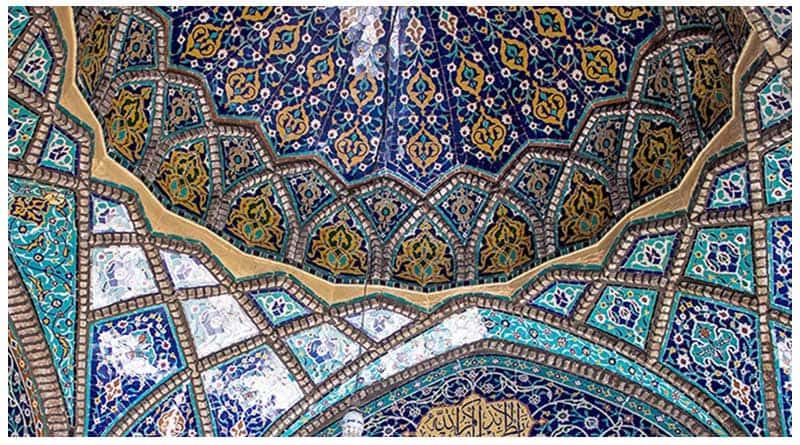
Geometry in Iranian architecture is a language that has transcended the boundaries of time and place. It speaks both to reason and logic, and to the human spirit and emotions. It responds to structural and climatic challenges while also embodying philosophical and mystical concepts. It gives buildings both order and stability, as well as beauty and grandeur. Perhaps the secret behind the enduring legacy of Iran’s architectural masterpieces lies in this profound connection between geometry, function, and meaning—a connection that Iranian architects brought to a remarkable level of refinement and passed down as an enduring heritage to humanity.
Behind every pointed arch, every turquoise dome, every intricate muqarnas, and every mesmerizing geometric pattern we see in Iranian architecture lies a silent yet powerful language—a language without which these masterpieces could not have taken their distinctive forms. That language is geometry. In Iranian architecture, geometry was not merely a technical tool for drawing plans and constructing buildings; it was an intellectual system, an aesthetic language, and a bridge between earth and sky. Through geometry, architects of the Iranian tradition could overcome structural and spatial challenges while also giving physical form to profound philosophical, mystical, and aesthetic ideas within architecture itself.
The roots of the emphasis on geometry in Iranian architecture can be traced back to the ancient civilizations of this land. In ancient Iran, mathematics and geometry were important fields of knowledge, and Achaemenid and Sasanian architects, drawing on their knowledge of these sciences, created monumental structures such as Persepolis and Taq Kasra. With the arrival of Islam in Iran, however, geometry entered a new phase. In the Islamic worldview, God is Jāmiʿ—the All-Embracing—and Aḥad—the One—and behind the infinite multiplicity and diversity of the world lies a fundamental unity. Geometry provided a visual language through which this metaphysical idea could be expressed. Thus, architects of the Iranian-Islamic tradition used geometry not only to address technical challenges, but also to give tangible form to profound philosophical, spiritual, and mystical ideas.
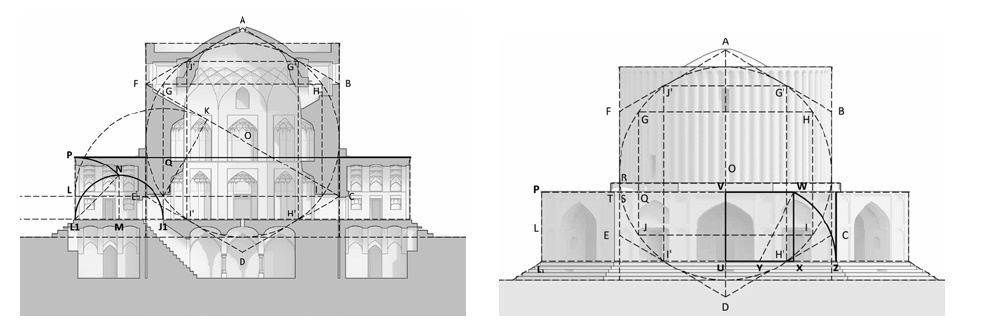
One of the fundamental geometric principles in Iranian architecture is the use of proportional systems and harmonious relationships between dimensions. Iranian architects employed various geometric ratios and proportional relationships to create spaces and volumes that feel balanced and visually harmonious. Such proportions, many of which can also be observed in nature, allowed buildings to appear well-balanced even when viewers were unaware of the mathematical principles underlying their design. For example, in the Jameh Mosque of Isfahan, the dimensions and relationships between the courtyard, iwans, and domed chambers reflect careful attention to proportion and geometry. As a result, despite the mosque’s vast scale, its spaces feel remarkably harmonious and balanced.
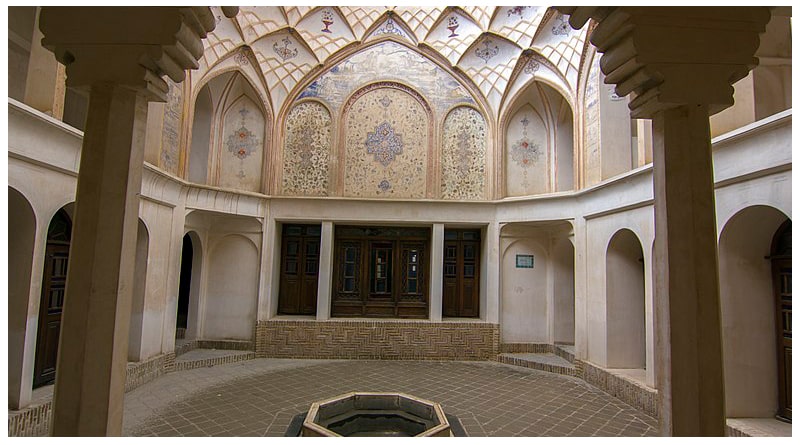
The second fundamental application of geometry lies in the transition from the square to the circle in the construction of domes. A dome, traditionally associated with the sky and divine unity, rises above a square space, which can be interpreted as representing the earthly realm and material multiplicity. This transition from square to circle presents a major geometric and structural challenge—one that Iranian architects addressed through the use of squinches and arched niches. In this technique, the square space at the base gradually transforms, through the addition of arched niches and squinches, into an octagonal form, and then into increasingly polygonal stages before reaching the circular base of the dome. This gradual transformation is not merely an ingenious structural solution; it can also be understood as a geometric metaphor for the human journey from multiplicity toward unity, and from earth toward the sky.
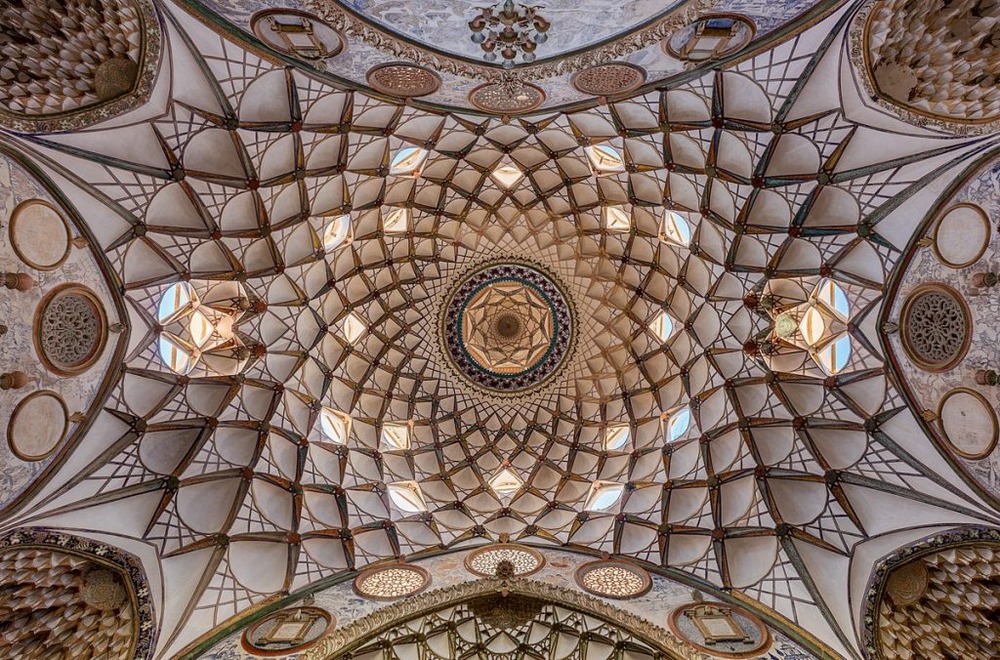
A third important expression of geometry in Iranian architecture can be found in muqarnas. Sometimes regarded as one of the early forms of three-dimensional geometric expression in architecture, muqarnas consist of a combination of repeated niches, projections, and recesses arranged according to precise geometric principles to create intricate, three-dimensional surfaces. Typically used in iwans, beneath domes, and above entrances, muqarnas served both architectural and ornamental purposes. They helped articulate the transition between different architectural surfaces and levels while creating an intricate interplay of light and shadow. In this way, they transformed architectural surfaces into dynamic compositions that naturally draw and captivate the eye.
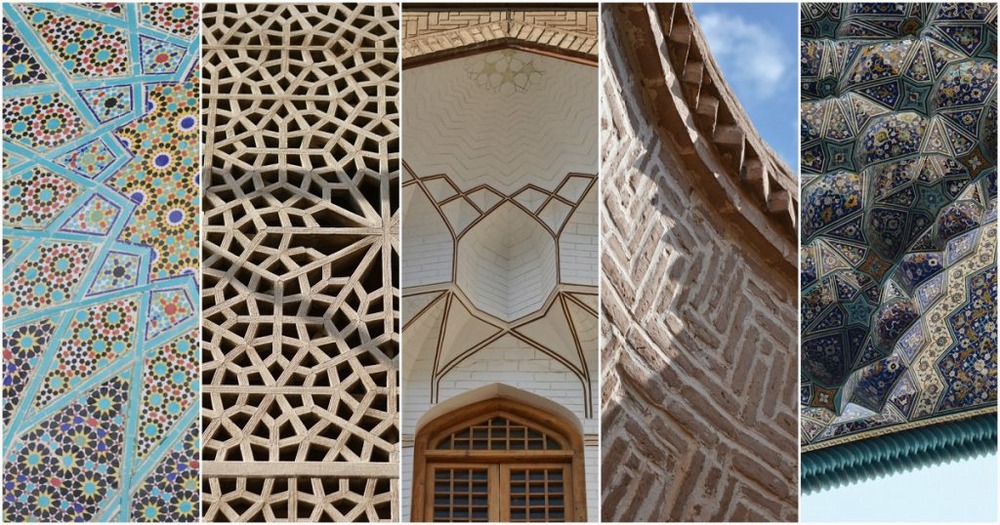
A fourth remarkable application of geometry is found in girih patterns and geometric ornamentation. Used in tilework, brickwork, stucco, mirrorwork, and woodcarving, girih consists of intricate geometric patterns created by repeating one or more basic units according to established rules. These patterns, often based on regular polygons such as hexagons, octagons, decagons, and dodecagons, can appear to extend indefinitely without being confined to a specific frame or boundary. This “infinite extension” of geometric patterns can itself be interpreted as a metaphor for divine and cosmic infinity.
Geometry also played a vital role in the orientation and positioning of buildings. Drawing on knowledge of astronomy and geometry, Iranian architects carefully oriented structures toward the qibla and in response to sunlight and prevailing winds. This precise orientation, applied in mosques, houses, windcatchers, and ice houses, demonstrates the deep connection between geometry, climate, and culture.
Perhaps one of the most significant examples of the application of geometry in Iranian architecture can be found in geometrically organized plans and deliberately planned cities. Cities such as Persepolis, Sasanian Bishapur, and Safavid Isfahan were laid out according to carefully conceived spatial and geometric principles. Naqsh-e Jahan Square in Isfahan is a precisely proportioned rectangle whose design reflects careful attention to geometric relationships and spatial proportions, while the buildings surrounding it form a unified and harmonious architectural ensemble. This geometric order at the urban scale illustrates the sophisticated understanding of spatial organization and proportion in Iranian architecture and city planning.
Today, geometry in Iranian architecture is not merely a historical legacy; it is also a source of inspiration for contemporary architects and designers. In an era when contemporary architecture can sometimes explore increasingly complex forms, returning to the geometric principles of Iranian architecture can offer a valuable perspective. Geometry teaches us that order, proportion, and harmony can form the foundations of beauty. Iranian geometric design also demonstrates how complex and breathtaking forms can emerge from the combination of simple basic units, following logical and repeatable rules.
Ultimately, geometry in Iranian architecture is more than a system of lines, angles, and proportions. It is a language that connects function with beauty, structure with meaning, and the physical world with the realm of ideas. Perhaps it is this profound unity of geometry, function, and meaning that has allowed Iran’s architectural masterpieces to endure across centuries and continue to speak to us today