Shushtar is a city in southern Iran, located in Khuzestan province, about 90 kilometers north of Ahvaz, the provincial capital. This ancient city, which served as the provincial center of Khuzestan in most historical periods—from the Sassanid era (224–651 CE) to the Pahlavi era (1925–1979 CE)—has gained worldwide fame for its ancient water structures.
These water structures consist of a set of 13 separate constructions that formed a system designed for the efficient use of water resources in irrigating the city's fields. In 2009, the Shushtar water structures were registered as a tangible cultural heritage site on the UNESCO World Heritage List, being described as a "masterpiece of creative genius."
The Shushtar water structures comprise bridges, dams, weirs, mills, waterfalls, canals, and tunnels. Jean Desoulofou, the famous French archaeologist, during his visit to Shushtar, described these water structures as the largest industrial complex before the Industrial Revolution.
History of the Shushtar Water Structures
Based on evidence, the foundation of these structures was laid during the Achaemenid period, in the 5th century BCE. Accordingly, the construction of these structures dates back to the reign of Darius I (522–486 BCE). However, the majority of the construction and development of these water structures belongs to the Sassanid era (224–651 CE).
Overall Structure of the Shushtar Water Structures
The Karun River, as the only navigable river in Iran, is the lifeline of Khuzestan. Before entering Shushtar, the river splits into two branches called Gargar and Shatit. Gargar is an artificial branch created during the reign of Ardashir I (465–424 BCE). The Gargar Dam was constructed on this canal during the Sassanid period to raise the water level.
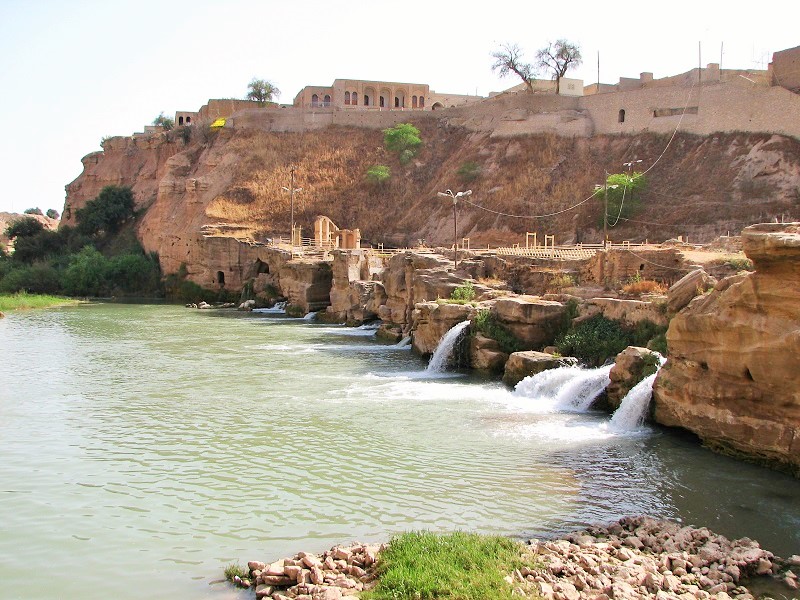
The water collected behind the Gargar Dam enters the Shushtar water structures through three tunnels. It is then distributed through numerous channels, which turn the mill wheels and eventually cascade into a pool as a waterfall.
Considering the engineering tools and calculation methods of ancient times, constructing such a precise and functional system is regarded as one of the masterpieces of civil engineering. The Sassanids used the Shushtar water structures to purify water and distribute it across different areas of Shushtar and surrounding cities. Considering that the main materials used in this complex are granite, gypsum, lime, and sarooj (a traditional waterproof mortar), the structure has remained durable over several centuries and is still in use today.
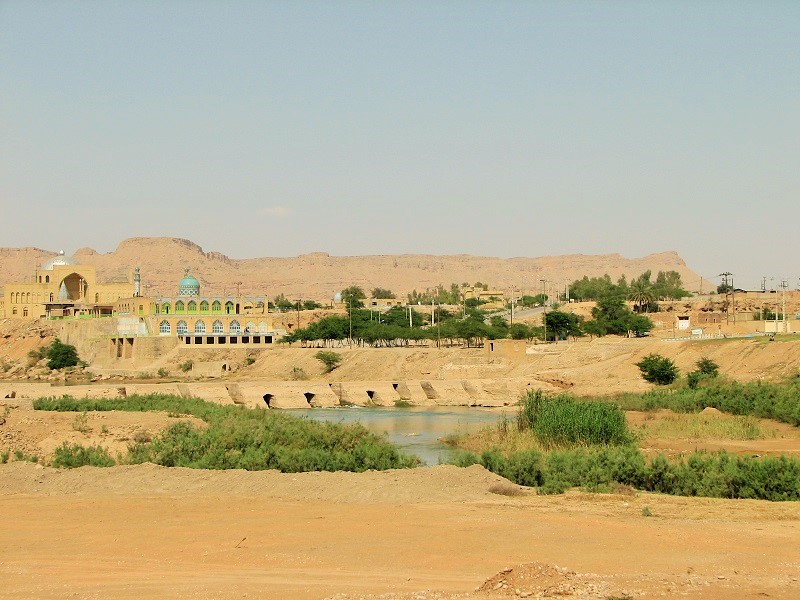
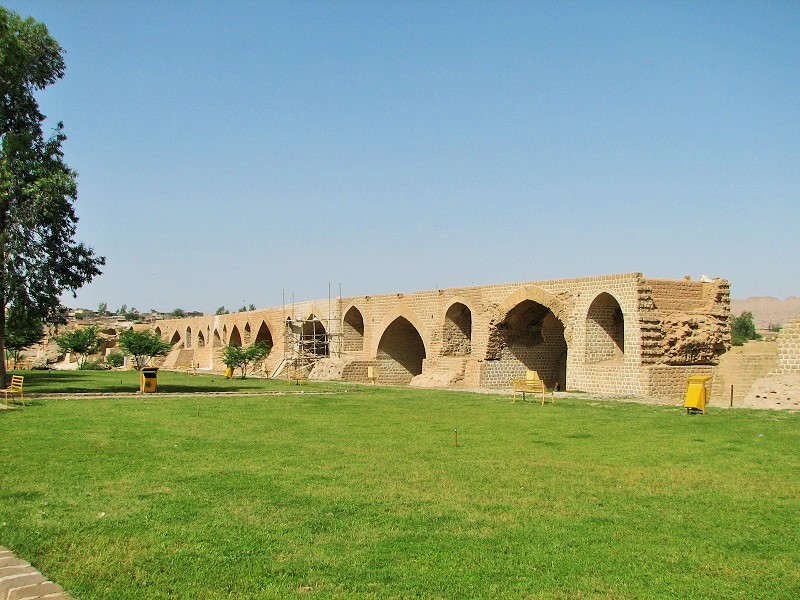
To examine it more precisely, the Shushtar water structures should be regarded as a complex composed of several components, each of which is introduced separately below: Shadervan Dam (Caesar’s Dam) This dam was constructed during the Sassanid period and includes 44 spillways. Shadervan Dam, considered the first structure in Iran to combine a bridge and a dam, can be regarded as the core of the Shushtar water structures. At present, 37 of its spillways remain intact. The dam is approximately 500 meters long, and nearly half of it has been reconstructed and restored.
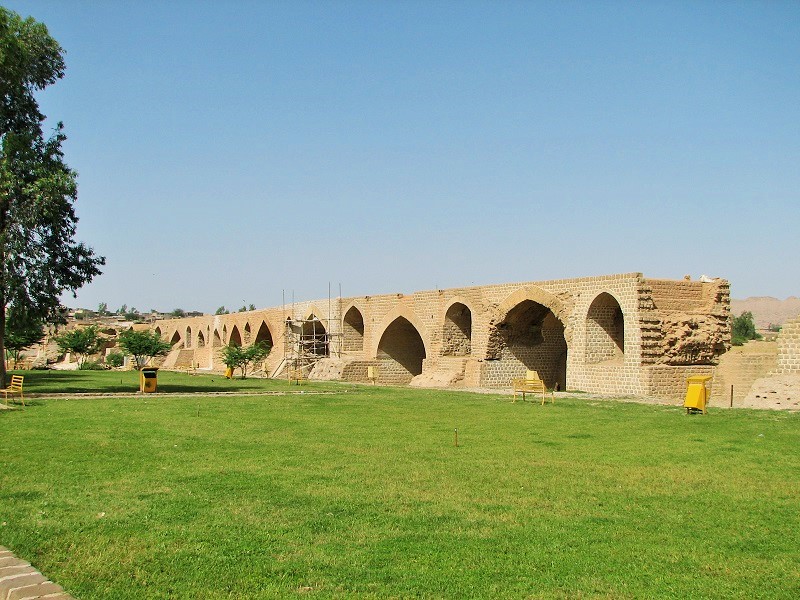
Shadrovan Bridge, one of the components of the Shushtar Historical Hydraulic System
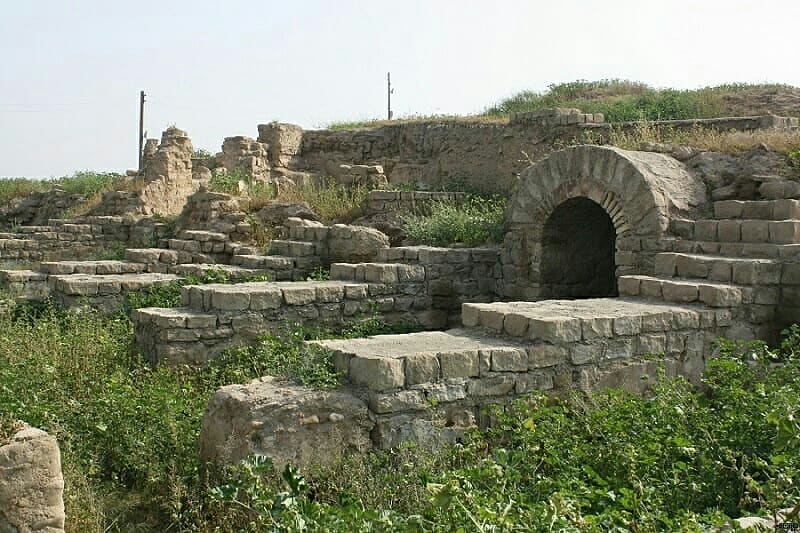
This dam is also known as “Caesar’s Dam”, because according to an ancient tradition, after Shapur I defeated the Romans and captured Valerian I, the Roman emperor, he employed Roman soldiers in the development of Shushtar and in the construction of this dam. Salasel Castle Historical sources date this fortress back to the Achaemenid period. The castle was built over the Dariyun (Dariyoon) Tunnel, which had been constructed during the reign of Darius and was responsible for irrigating the Mianab Plain of Shushtar. Today, only the remains of its underground chambers and the Dariyun tunnels have survived.
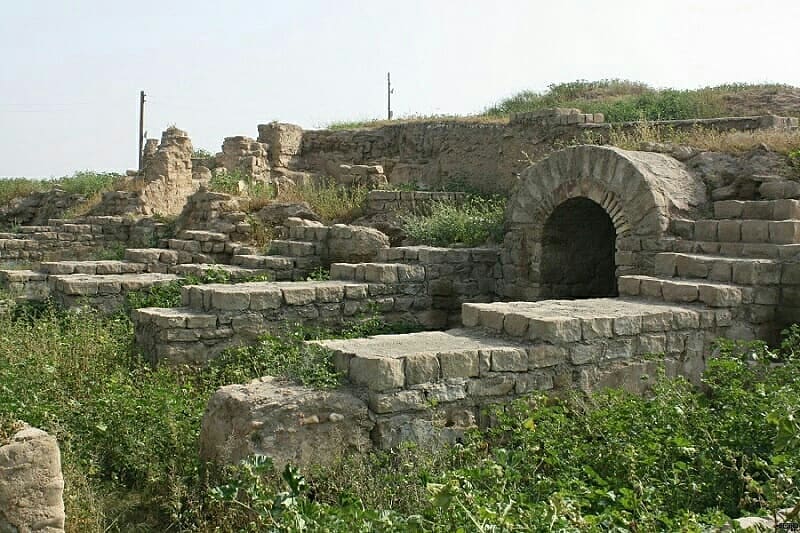
Remains of the Salasel Castle of Shushtar
The presence of large and numerous courtyards, barracks, stables, bathhouses, watchtowers, gardens, an armory, a naqareh-khaneh (drum house), a harem, kitchens, large pools, fortifications, and a moat within the castle complex indicates that it functioned as an operational and administrative center. In addition to the Darion Canal, branches of the Shatit River were also controlled through this castle.
Mizan Dam
The construction of this dam is attributed to the reign of Shapur I (240–270 AD). Through this dam, the Karun River is divided in specific proportions into its two branches, the Shatit and the Gargar. The design of the dam is such that if the water level in either branch exceeds a certain limit, the excess water is diverted to the other channel. The water purification technology employed in this dam is considered a masterpiece of ancient architectural and engineering achievement.
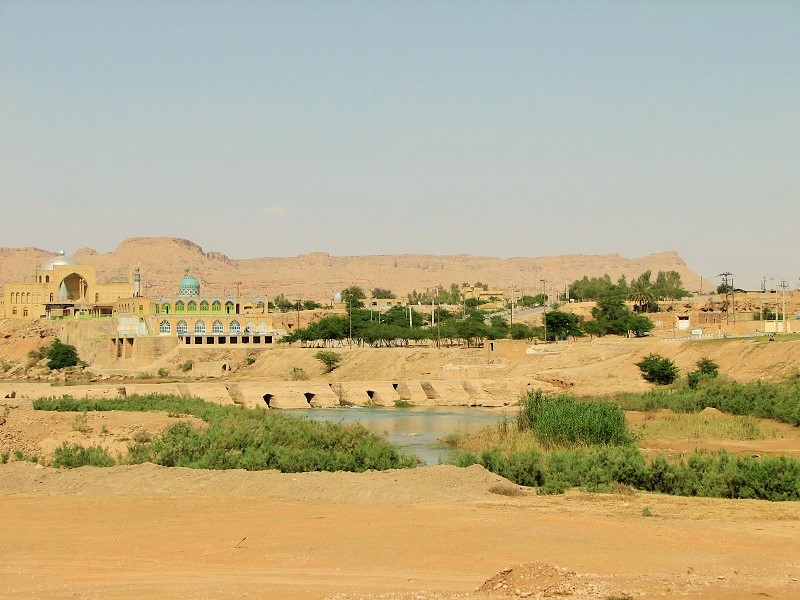
Mizan Dam, Part of the Shushtar Historical Hydraulic System
Mahibazan Dam
This dam was also constructed during the Sassanian period, using a single, integrated bedrock foundation. The bedrock was deliberately modified, and three walls were built within it in order to increase water pressure and maintain a higher water level.
Lashkar Bridge-Dam
Shushtar once had six historical gates, and beyond one of them stood a bridge-dam known as Lashkar. Today, remnants of this gate still remain, indicating that the structure was part of the Shushtar hydraulic system. It is believed to have been built during the Sassanian period; however, during restoration work in 2009, two graves were discovered near the bridge’s foundations, dating back to the Parthian period (247 BC–224 AD). The canal passing beneath the bridge is a branch of the Darion Canal, known as Raqt, which flows into the Gargar River.
Khak Dam
This structure, dating back to the Sassanian era, transfers water from the Darion Canal to the Raqt Canal. Its function was to divert excess water during times when the Darion overflowed and flooding threatened the Miyanab Plain.
Sharabdar Dam
Built on the Raqt Canal along an east–west axis, the Sharabdar Dam also dates to the Sassanian period. The eastern section of the dam is connected to part of the city’s fortress.
Borj-e Ayyar Dam
Another Sassanian-era structure, this dam is located along the course of the Gargar Canal, downstream from the waterfalls.
Shah Ali Bridge-Dam
This dam was constructed on the Darion Canal during the Safavid period (1501–1736 AD). Compared to other components of the Shushtar hydraulic system, it is relatively recent in age.
Kolāh Farangi
This structure consists of the remains of an octagonal tower beside the Shatit River, built on a hill overlooking the Mizan Dam. Dating to the Qajar period (1796–1925 AD), the Kolāh Farangi was used as a watchtower.
Water Mills
The main elements of the Shushtar hydraulic system are its waterfalls and water mills, all of which date back to the Sassanian era. A complex of 32 water mills, along with numerous waterfalls, creates a striking harmony between the architectural components and the flowing water, highlighting the ingenuity and aesthetic vision of the system’s designers.
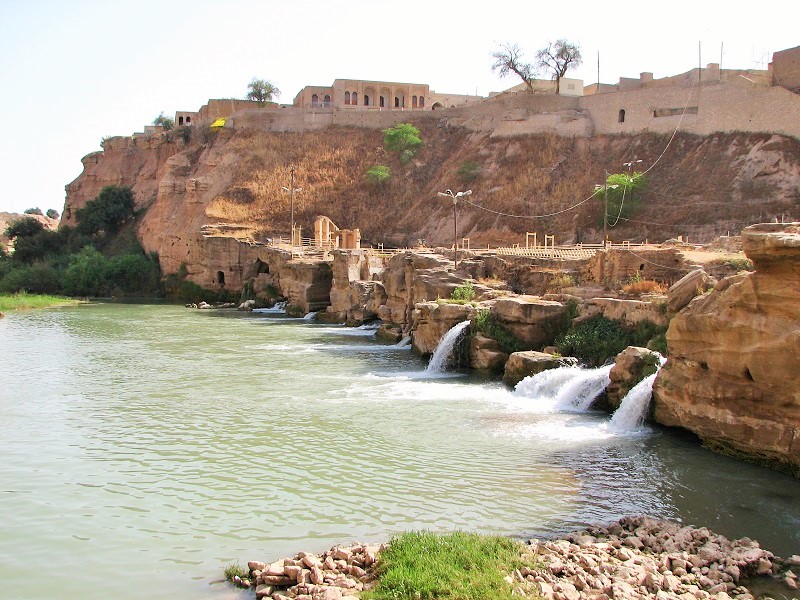
Part of the Waterfalls and Water Mills of the Shushtar Historical Hydraulic System
Ancient Hand-Carved Stairway
A complex consisting of 200 steps is located to the south of the waterfall area, connecting it to the residential neighborhoods overlooking the site. Several inscriptions can be found along this stairway, indicating the date of its construction.
National and World Registration of the Shushtar Hydraulic System
The Shushtar Historical Hydraulic System was inscribed on the UNESCO World Heritage List in 2009 (1388 Solar Hijri) during the 33rd session of UNESCO, as a tangible cultural heritage site, and was awarded the title “a masterpiece of creative genius.” Prior to this, the site had been registered as a National Heritage of Iran in 1998 (1377 Solar Hijri).