

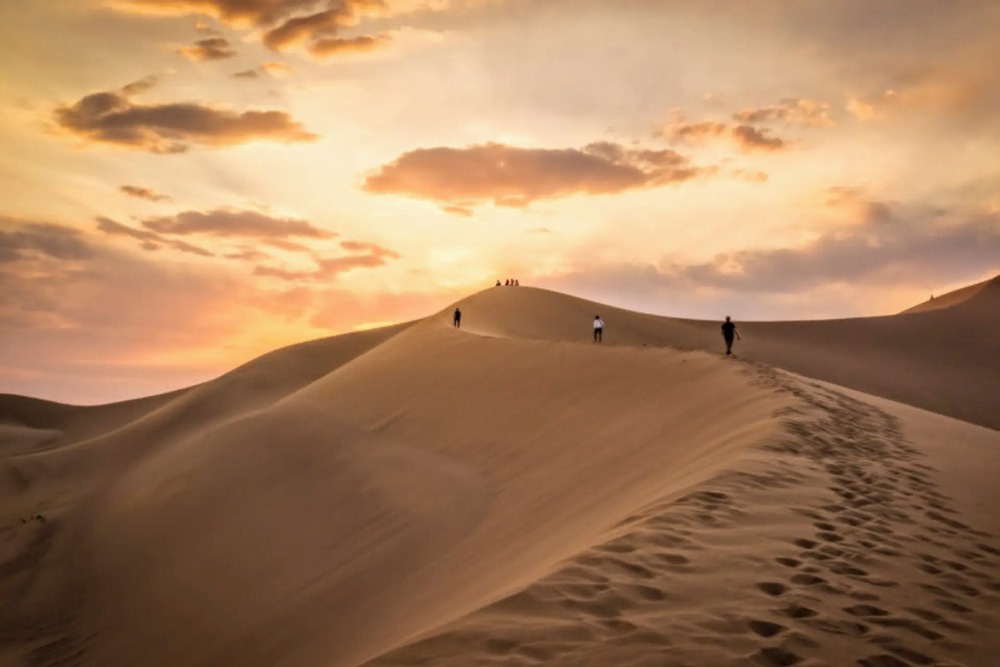
In the heart of Iran’s central plateau, where the earth and sky meet along an endless horizon and the sun shines relentlessly upon the land, a city has emerged that quietly whispers one of the greatest lessons in the history of architecture: “It is possible to live in harmony with nature without destroying it.”
This city is Yazd, a UNESCO World Heritage Site, which has created one of the most ingenious systems of human habitation—not through marble palaces, but through mud, adobe, and wind. If you are searching for one of the earliest inspirations for sustainable architecture, you must travel to Yazd; for this philosophy is not found only in the writings of contemporary theorists, but has been practiced for centuries in the earthen alleys of this remarkable city.
Yazd is a story of a magnificent paradox: how did a civilization flourish and create some of its most remarkable monuments in one of the harshest climates on Earth—where annual rainfall barely exceeds 60 millimeters and summer temperatures rise above 45 degrees Celsius?
The answer lies not in conquering nature, but living in harmony with it. Instead of fighting the desert, the people of Yazd learned to speak the language of the desert. They transformed earth into shelter, wind into a cooling system, and qanats into the lifelines of their civilization.
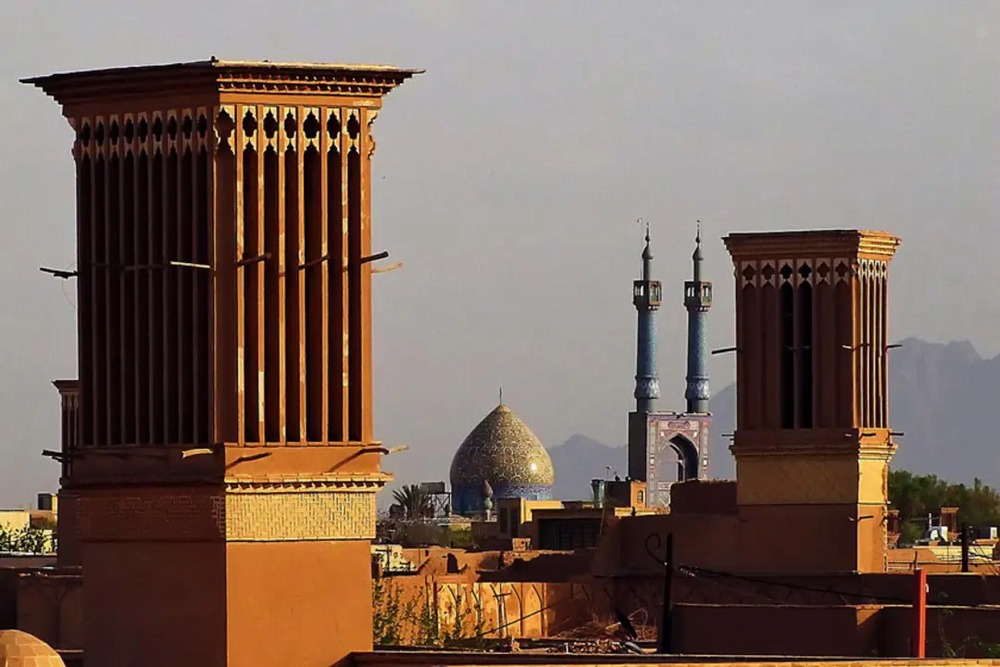
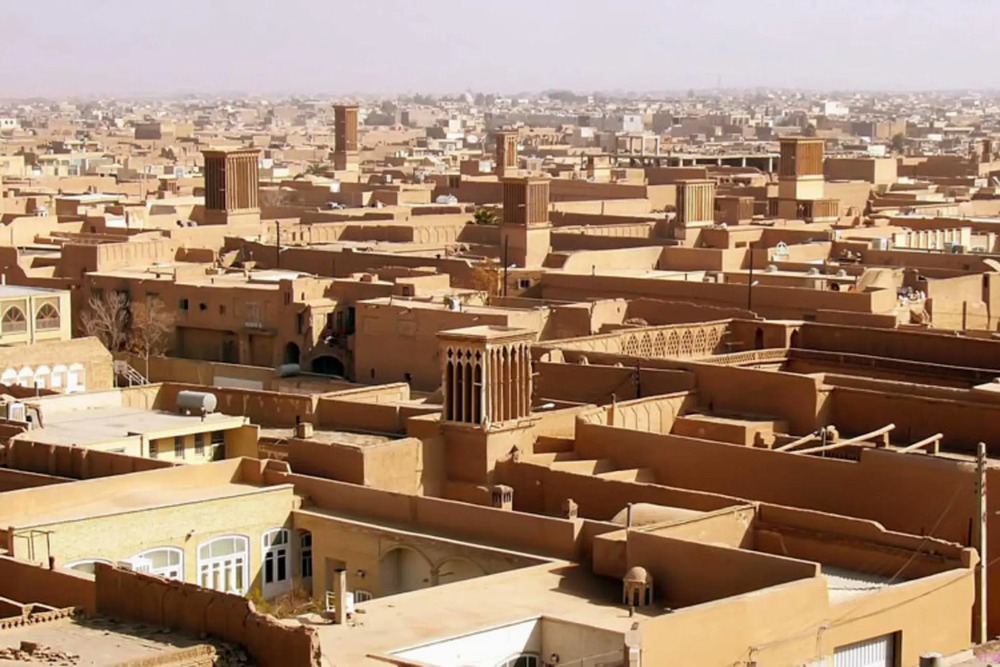
The undisputed symbol of this architecture is the windcatcher: those towering adobe structures that rise above Yazd’s skyline like crowns adorning the historic fabric of the city. To an unfamiliar eye, a windcatcher may appear to be merely a decorative feature or a symbol of the past. In reality, however, these structures are the heart of an extraordinarily advanced natural ventilation system that provided comfort to desert inhabitants centuries before the invention of electricity.
The mechanism of the windcatcher is deceptively simple, yet remarkably sophisticated. Its upper openings capture the wind from whichever direction it blows and guide it downward through vertical shafts. As the airflow passes over the surface of small pools of water in the courtyard, or moves across the damp walls of underground spaces, it becomes cooler and more pleasant, filling the summer rooms of the house with a gentle and refreshing breeze.
It is a natural “evaporative cooler” that consumes no energy other than the power of the wind itself. The windcatchers of Yazd are evidence that long before the term “sustainable architecture” was coined, our ancestors had already mastered the principles of climate-responsive design. These structures give physical form to an invisible force.
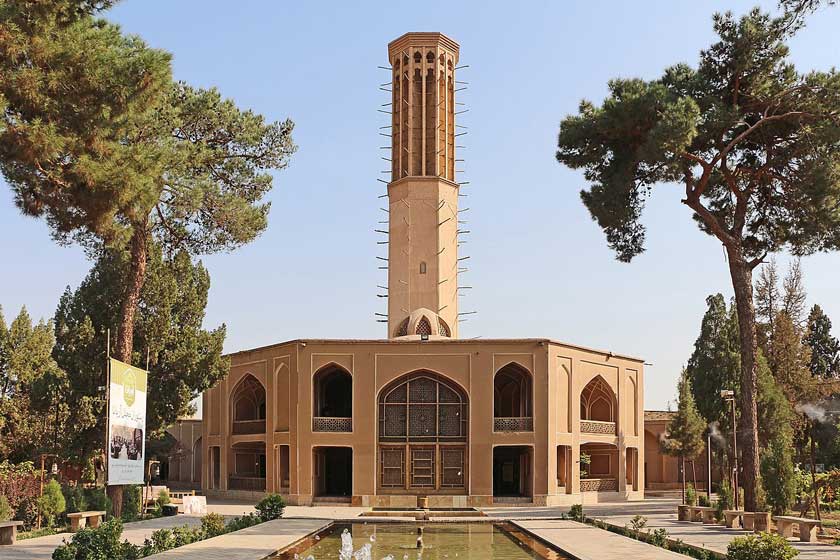
Yet windcatchers were not all created in the same way. Walking through the different neighborhoods of Yazd offers a complete lesson in the typology of these architectural masterpieces. The four-sided and eight-sided windcatchers of the Dowlatabad Garden, rising 33 meters high and recognized as oe of the tallest windcatcher in the world, reveal the wealth and influence of their patrons through their elegance and astonishing proportions.
In contrast, the simple single-direction windcatchers of local houses represent the most practical response to the prevailing winds of the region. This diversity demonstrates that Yazd’s architecture, before seeking abstract beauty, was first concerned with “function.” Yet through this functional approach, it achieved a unique and poetic aesthetic—a beauty born from honesty and harmony with the forces of nature.
The City of Hidden Water: Architecture in the Service of Life
If the windcatcher is the symbol of Yazd’s sky, the qanat is the lifeline flowing beneath its earth. This ancient underground water-supply system, which includes Iran’s longest qanat—the Zarch Qanat, extending for more than 70 kilometers—is one of the most remarkable achievements in the history of human engineering. Yet its influence on Yazd’s architecture extends far beyond providing drinking water. The qanat shaped the city’s spaces, the hierarchy of its neighborhoods, and even the social ethics of its inhabitants.
By following the path of the qanat, one can discover an entire underground architectural system . Several meters beneath the surface, Paay Abs (traditional underground water-access chambers) and subterranean chambers were constructed, becoming the coolest places in the city during the height of summer. These dimly lit and tranquil spaces provided refuge from the intense heat, and their architecture— brick vaults and earthen walls —possesses such a sense of purity and harmony that entering them feels almost like stepping into an underground temple.
Here, architecture has embraced the earth not merely as a foundation, but as a partner. The dialogue between “above” (the windcatchers) and “below” (the qanats and underground chambers) creates a holistic heating and cooling system that encompasses the entire city of Yazd.
Urban Fabric: A Labyrinth Designed for Life
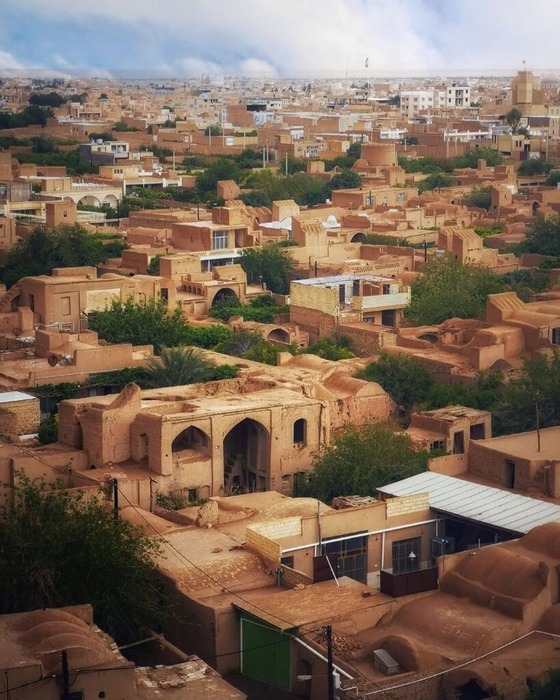
The historic core of Yazd is and a complex living organism, where every street and alley has been designed according to climatic principles. The narrow, winding lanes—many of them covered by structures known as sabats—are not simply the result of unplanned urban growth. These passages were carefully designed to remain shaded throughout the day and to regulate the movement of air.
By creating shaded tunnels, sabats generate a cool microclimate within the heart of the city and protect pedestrians from the harsh desert sun.
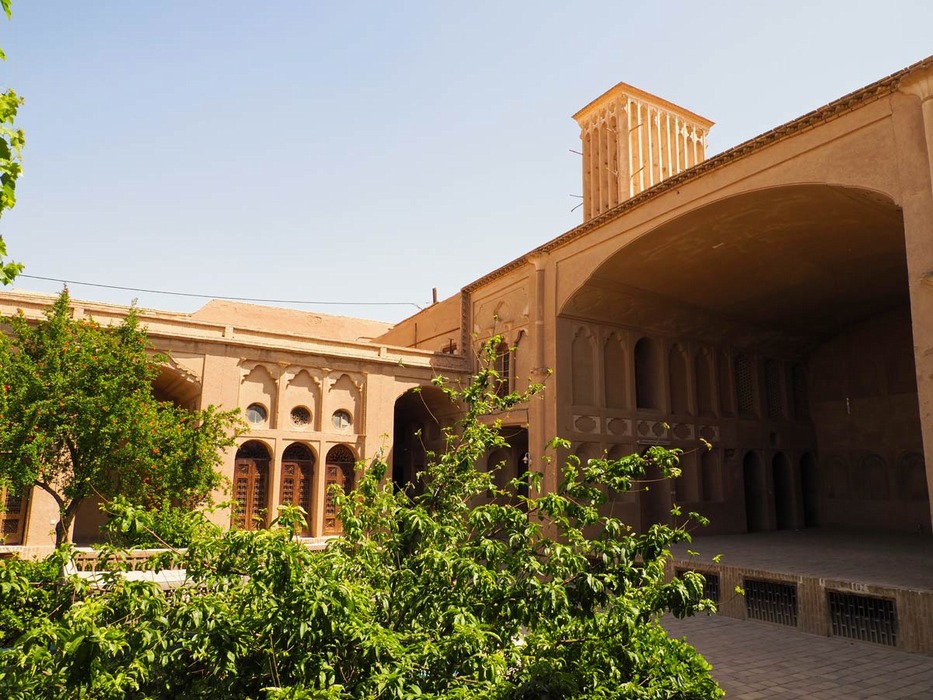
In this dense urban fabric, houses—with their tall adobe walls—are deeply inward-looking. Their exterior façades rarely contain windows, yet behind these simple earthen walls lie central courtyards transformed into small gardens of pomegranate trees, grapevines, and geraniums.
The contrast between the “harsh and minimalist exterior” and the “green and vibrant interior” is one of the fundamental principles of traditional Iranian architecture, reaching its highest expression in Yazd. The central courtyard, with a pool at its center, is not merely an aesthetic space; it is a natural climate-control system that channels light and humidity deep into the interior spaces of the house.
Yazd’s Lessons for the Modern World
But why does the architecture of Yazd matter to a twenty-first-century citizen—whether in Tehran, New York, or Tokyo? The significance of Yazd extends far beyond being a beautiful tourist destination. This city is a living laboratory for addressing one of humanity’s most urgent questions today: How can we achieve a high quality of life while causing the least possible harm to the environment?
The first lesson of Yazd is “architecture with what is available.” The primary building materials of Yazd—adobe and mud—come directly from the desert soil itself. These materials not only require little energy for production and transportation, but also possess high thermal mass, meaning they absorb heat during the day and gradually release it at night, reducing temperature fluctuations.
This is a completely natural passive system. Yazd demonstrates that sustainable architecture does not necessarily depend on complex and expensive technologies; rather, it can be built upon a profound understanding of the environment, local resources, and indigenous materials.
The second lesson is “designing for the integration of systems.” In Yazd, water (the qanat), wind (the windcatcher), earth (building materials), and space (the central courtyard and underground chambers) were not regarded as separate elements. Instead, they formed parts of a holistic system in which each component worked in harmony with the others.
This systems-based way of thinking is the essence of Yazd’s architecture and serves as an antidote to an alternative to architectural approaches that isolate buildings from their environment that views a building as an independent box, detached from its surrounding environment.
The third, and perhaps the most profound, lesson of Yazd is the emergence of an aesthetic shaped by necessity. The windcatchers, sabats, and adobe domes of Yazd are not merely functional elements; they have created a poetic and unified urban landscape. This city reminds us that a “ authentic ” building—one that bows to the forces of nature and moves in harmony with them—is inherently beautiful.
Yazd is not a silent city; it is a city where wind and earth are in constant dialogue. It is a place where architecture is built not upon the land, but with the land; not against the climate, but in harmony with it. For a world that grows warmer each day and faces increasingly scarce resources, Yazd is not merely a memory of the past; it is a guide for the future.